Types of Memory: Sensory, Working, and Long-Term
Memory is one of the most remarkable functions of the human brain. It allows us to learn from experiences, recognize people and places, develop skills, solve problems, and build our personal identity.
Every conversation you remember, every skill you master, and every life event you cherish depends on memory. Without it, daily functioning would be nearly impossible.
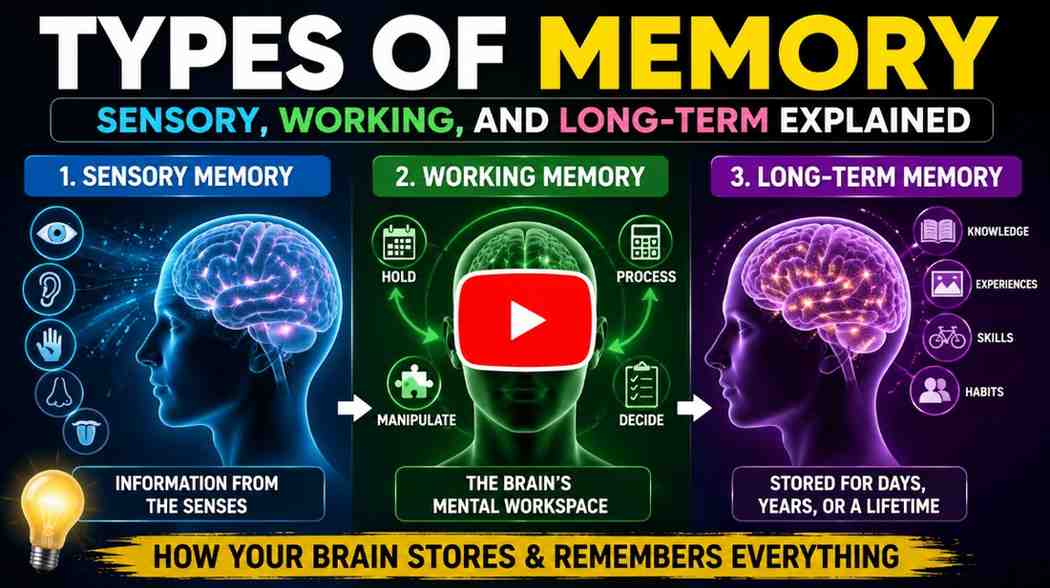
Researchers generally classify memory into three primary categories: sensory memory, working memory, and long-term memory.
These systems work together continuously, allowing the brain to receive information, process it, and store it for future use.
Understanding how these memory types function can help explain why we remember some things instantly, forget others quickly, and retain certain experiences for a lifetime.

In this guide, we will explore the different types of memory, how they interact, their roles in learning and cognition, factors that affect memory performance, and practical ways to improve memory health.
Understanding Memory
Memory is the brain’s ability to encode, store, and retrieve information. It is not a single process but rather a complex network involving multiple brain regions working together. Information enters through the senses, is processed, and may eventually be stored as a lasting memory.
Scientists often describe memory using the information-processing model. According to this model, information moves through three major stages:
- Sensory Memory
- Working (Short-Term) Memory
- Long-Term Memory
Each stage serves a unique purpose and has different storage capacities and durations.
Why Memory Matters
Memory plays a crucial role in nearly every aspect of life. It helps us:
- Learn new information
- Develop language skills
- Make decisions
- Solve problems
- Perform everyday tasks
- Build relationships
- Navigate environments
- Maintain personal identity
From remembering a friend’s name to recalling complex professional knowledge, memory supports both simple and sophisticated cognitive functions.
Sensory Memory
Sensory memory is the first stage of memory processing. It acts as a temporary holding area for information received through the senses.
Every second, our environment provides an enormous amount of visual, auditory, tactile, olfactory, and gustatory information.
The brain cannot consciously process every detail, so sensory memory briefly stores incoming information, allowing the brain to determine what deserves attention.
How Sensory Memory Works
Sensory memory lasts only a fraction of a second to a few seconds. Despite its brief duration, it captures highly detailed information from the environment.
For example:
- Seeing a flash of lightning
- Hearing a sudden sound
- Feeling a tap on the shoulder
- Smelling freshly baked bread
Most sensory information disappears almost immediately unless attention is directed toward it. Once attention is focused, information moves into working memory for further processing.
Types of Sensory Memory
Iconic Memory
Iconic memory refers to visual sensory memory.
It stores visual information for a very brief period after an image disappears. This allows people to perceive smooth movement rather than disconnected visual snapshots.
Examples include:
- Seeing motion in a movie
- Reading text across a page
- Tracking moving objects
Echoic Memory
Echoic memory stores auditory information.
It allows people to retain sounds briefly after hearing them, making conversations possible even when attention shifts momentarily.
Examples include:
- Remembering the last few words someone said
- Processing spoken instructions
- Following conversations in noisy environments
Haptic Memory
Haptic memory relates to touch sensations.
It stores information about textures, pressure, temperature, and physical contact for a short period.
Examples include:
- Feeling the texture of fabric
- Remembering the sensation of a handshake
- Recognizing an object’s shape through touch
Olfactory and Gustatory Memory
These involve smell and taste.
Although less studied, they contribute significantly to emotional experiences and memory formation.
Examples include:
- Recognizing a familiar perfume
- Remembering a favorite childhood meal
Characteristics of Sensory Memory
Sensory memory has several defining features:
- Extremely short duration
- High information capacity
- Automatic processing
- Detailed sensory representation
- Serves as a gateway to higher memory systems
Without sensory memory, the world would feel fragmented and difficult to understand.
Working Memory
Working memory is often described as the brain’s mental workspace. It temporarily stores and actively manipulates information needed for reasoning, learning, decision-making, and problem-solving.
Unlike sensory memory, which passively records information, working memory actively processes information.
What Is Working Memory?
Working memory holds information for immediate use. It allows people to maintain information while performing mental tasks.
For example:
- Solving a math problem
- Following directions
- Understanding a sentence
- Planning a schedule
- Comparing options before making decisions
These activities require information to remain available while being manipulated mentally.
Working Memory vs. Short-Term Memory
Many people use the terms interchangeably, but researchers often distinguish them.
Short-term memory primarily stores information temporarily.
Working memory not only stores information but also manipulates it to support cognitive tasks.
For example:
- Remembering a phone number briefly involves short-term memory.
- Performing mental calculations using that number involves working memory.
Working memory is therefore considered a more active system.
Examples of Working Memory
Working memory is involved in countless daily activities:
- Reading: While reading a paragraph, working memory holds earlier sentences while integrating new information.
- Mental Arithmetic: Calculating 27 + 38 requires holding numbers while performing operations.
- Conversation: Working memory helps people remember previous statements while formulating responses.
- Following Instructions: Multi-step directions depend heavily on working memory.
- Problem-Solving: Complex reasoning tasks require temporarily storing and manipulating information.

Capacity of Working Memory
Working memory has limited capacity.
Most people can only maintain a small amount of information simultaneously. Once this capacity is exceeded, information may be forgotten unless organized effectively.
Researchers have identified strategies that help expand functional capacity:
Chunking
Grouping information into meaningful units.
Examples:
- Breaking phone numbers into sections
- Organizing information into categories
Rehearsal
Repeating information mentally.
Examples:
- Repeating a name after introduction
- Practicing a speech
These strategies improve retention and facilitate transfer to long-term memory.
Brain Regions Involved in Working Memory
Working memory relies heavily on the prefrontal cortex, a region associated with executive functions such as planning, attention, and decision-making.
Additional brain areas contribute depending on the type of information being processed.
These interconnected networks allow individuals to temporarily maintain and manipulate information effectively.
Long-Term Memory
Long-term memory serves as the brain’s vast storage system. It contains information that can remain accessible for days, years, or even an entire lifetime.
Unlike working memory, long-term memory has an enormous capacity.
What Is Long-Term Memory?
Long-term memory stores experiences, knowledge, skills, and personal information over extended periods.
Examples include:
- Childhood memories
- Historical facts
- Language knowledge
- Professional expertise
- Motor skills
Long-term memories often become more stable through repetition, emotional significance, and meaningful learning experiences.
How Information Reaches Long-Term Memory
Information typically follows this pathway:
Sensory Memory → Working Memory → Long-Term Memory
When information receives sufficient attention and rehearsal, the brain strengthens neural connections, increasing the likelihood of long-term storage.
This process is known as memory consolidation.
Types of Long-Term Memory
Long-term memory is generally divided into two broad categories:
- Explicit (Declarative) Memory
- Implicit (Non-Declarative) Memory
Explicit Memory
Explicit memory involves conscious recall of information.
People intentionally access these memories when answering questions or recalling events.
Episodic Memory
Episodic memory stores personal experiences.
Examples include:
- Graduation day
- Wedding celebrations
- Family vacations
- First day at a new job
These memories often contain contextual details such as time, location, and emotions.
Semantic Memory
Semantic memory stores factual knowledge.
Examples include:
- Capital cities
- Mathematical formulas
- Vocabulary
- Historical information
Unlike episodic memory, semantic memory is not tied to specific personal experiences.
Implicit Memory
Implicit memory influences behavior without conscious awareness.
Procedural Memory
Procedural memory stores learned skills and habits.
Examples include:
- Riding a bicycle
- Driving a car
- Typing on a keyboard
- Swimming
Once learned, these skills often become automatic.
Associative Learning
This involves linking related experiences.
Examples include:
- Recognizing familiar sounds
- Developing conditioned responses
- Learning patterns
Priming
Prior exposure influences future responses.
For example, seeing a word repeatedly can make it easier to recognize later.
How the Three Memory Systems Work Together
Memory systems do not function independently.
Instead, they operate as an integrated network.
Imagine meeting someone at a conference:
Step 1: Sensory Memory
You see their face and hear their name.
Step 2: Working Memory
You repeat the name mentally and engage in conversation.
Step 3: Long-Term Memory
Later, you remember the person’s name and where you met.
This seamless transition demonstrates how information moves through different memory stages.
Factors That Influence Memory Performance
Several factors affect how effectively memories are formed and retrieved.
- Attention: Information that receives focused attention is more likely to enter working memory and eventually long-term memory.
- Sleep: Sleep supports memory consolidation and learning. Poor sleep can impair memory formation and retrieval.
- Stress: Chronic stress may interfere with memory processing and concentration.
- Aging: Normal aging can slow memory retrieval, though significant memory decline may indicate underlying conditions.
- Nutrition: The brain requires adequate nutrients to support healthy cognitive function.
- Physical Activity: Regular exercise supports blood flow and brain health.
Common Memory Problems
Everyone experiences occasional memory lapses.
Examples include:
- Forgetting names
- Misplacing items
- Missing appointments
- Losing track of conversations
More serious memory difficulties may result from neurological disorders, injuries, medication effects, sleep disorders, or mental health conditions.
A healthcare professional should evaluate persistent memory concerns.
Strategies to Improve Memory
Although memory naturally changes over time, several evidence-based habits can support cognitive performance.
- Stay Mentally Active: Activities such as reading, puzzles, learning new skills, and continuing education stimulate the brain.
- Exercise Regularly: Physical activity supports brain health and cognitive function.
- Prioritize Sleep: Quality sleep strengthens memory consolidation.
- Practice Mindfulness: Reducing stress can improve attention and memory performance.
- Use Memory Techniques:
Helpful methods include:
- Chunking
- Visualization
- Repetition
- Association techniques
- Mnemonic devices
Maintain Social Connections: Social interaction stimulates cognitive activity and emotional well-being.
The Future of Memory Research
Scientists continue exploring how memories are formed, stored, and retrieved. Advances in neuroscience are improving our understanding of memory-related disorders and revealing new possibilities for treatment.
Research into brain plasticity, memory consolidation, aging, and neurodegenerative diseases may eventually lead to more effective strategies for preserving cognitive function throughout life.
Conclusion
Memory is a sophisticated system that allows humans to learn, adapt, and navigate the world. The three primary types of memory sensory memory, working memory, and long-term memory work together to transform fleeting experiences into lasting knowledge and skills.
Sensory memory briefly captures information from the environment, working memory actively processes and manipulates information, and long-term memory stores experiences, knowledge, and abilities for future use.
Understanding these systems provides valuable insight into how learning occurs and why certain information is remembered while other details fade away.
By maintaining healthy lifestyle habits, staying mentally engaged, managing stress, exercising regularly, and prioritizing sleep, individuals can support memory function and cognitive health throughout their lives.
As research continues to advance, our understanding of memory will likely deepen, offering new opportunities to preserve and enhance this essential aspect of human cognition.
References
https://en.wikipedia.org/wiki/Memory
https://www.healthline.com/health/types-of-memory
https://www.webmd.com/alzheimers/types-of-memory
.
About Us