
False Memories: Causes Behind Memory Distortion Explained
False Memories: Causes Behind Memory Distortion
Memory is often treated as a reliable record of our experiences, but decades of psychological research show that human memory is reconstructive rather than photographic.
This means that every time we remember something, our brain actively rebuilds the event using fragments of stored information, emotions, beliefs, and external cues.
Because of this reconstructive process, memories can sometimes become distorted or even entirely false. These distortions are known as false memories, and they can feel just as real and vivid as true memories.
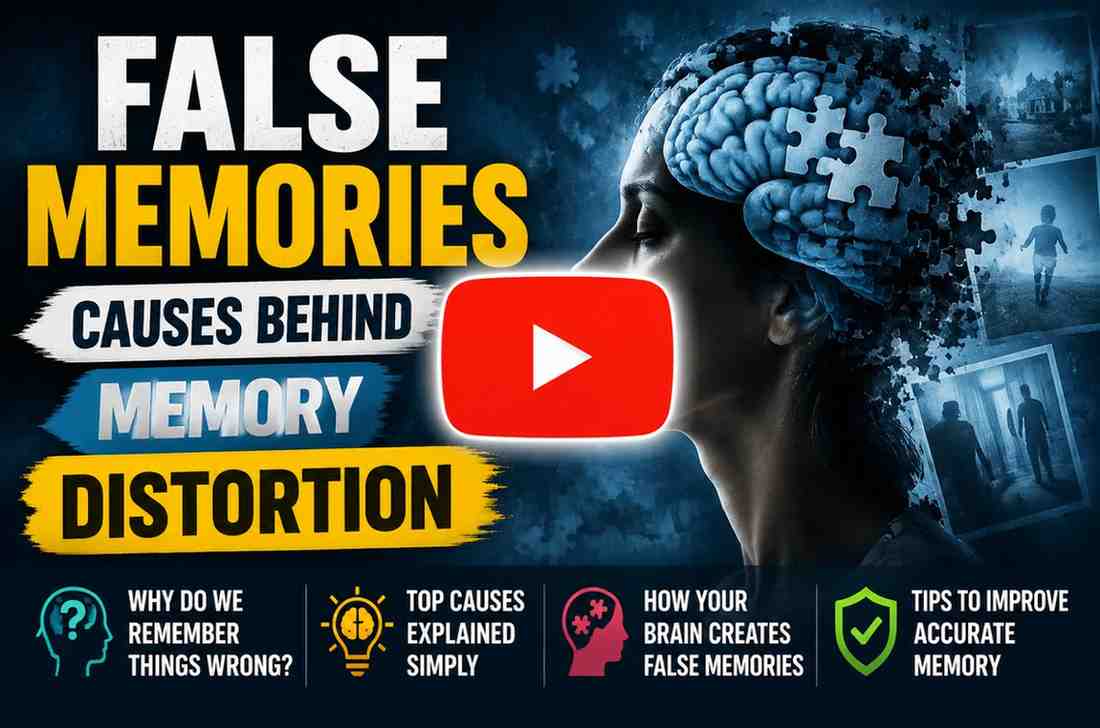

False memories are not rare or abnormal; they are a natural byproduct of how the brain processes and stores information. Researchers define them as recollections of events that either did not happen at all or occurred differently from how they are remembered.
Understanding why false memories form is important not only for psychology but also for real-life situations such as eyewitness testimony, therapy, education, and even everyday decision-making.
What Are False Memories?
A false memory is a mental experience in which a person remembers something inaccurately or recalls something that never actually occurred. These memories may be:
- Completely invented events
- Distorted versions of real experiences
- Misattributed memories from another source
- Blended memories formed from multiple events
Importantly, false memories are not lies. The person genuinely believes the memory is real.
Memory researchers emphasize that human recall is highly flexible and influenced by how information is stored, retrieved, and reconstructed over time.
How does memory distortion happen?
To understand false memories, it helps to understand how normal memory works. When we experience an event, the brain does not store it like a video recording. Instead, it encodes:
- Key sensory details (images, sounds, emotions)
- Meaning or “gist” of the event
- Context and associations
Later, when we recall the memory, the brain rebuilds it using these fragments. During this reconstruction process, errors can enter.
Common mechanisms of distortion include:
- Missing details filled in by imagination
- Confusion about when or where something happened
- Mixing real and imagined events
- Influence from outside information
Over time, repeated recall can strengthen distortions, making false memories feel more authentic.
Major Causes Behind False Memories
1. Misinformation Effect
One of the most studied causes of memory distortion is the misinformation effect. This occurs when a person is exposed to incorrect information after an event, which then becomes integrated into their memory.
For example:
- A witness sees a car accident involving a stop sign
- Later, they hear someone say it was a yield sign
- Over time, they may remember the incorrect version
Even small suggestions, leading questions, or media exposure can reshape memory without the person realizing it.
2. Source Monitoring Errors
Source monitoring refers to the brain’s ability to identify where a memory came from. When this system fails, people may be confused:
- Something they imagined with something they experienced
- A dream with a real event
- A story they heard with something they personally lived through
These errors are a major cause of false memories because the content feels familiar, even if the source is incorrect.

3. Suggestions and Leading Questions
Human memory is highly sensitive to suggestion. When someone repeatedly hears a certain version of an event, especially from authority figures or trusted individuals, the brain may incorporate it into memory.
Examples include:
- Therapy sessions using suggestive questioning
- Police interviews with leading questions
- Conversations with confident storytellers
Over time, suggestions can lead to full memory reconstruction, even of events that never occurred.
4. Gist-Based Memory Processing
The brain tends to remember the general meaning (gist) of an event rather than precise details. While this is efficient, it increases the chance of distortion.
For instance:
- You remember attending a wedding, but forget the exact details
- Later, your brain fills in missing elements based on expectations of weddings
- These “filling-in” details may be inaccurate, but they feel real
Gist-based processing is one of the most common cognitive pathways leading to memory errors.
5. Emotional Influence and Trauma
Strong emotions can both enhance and distort memory. Emotional experiences often feel more vivid, but they are not necessarily more accurate.
Research shows that individuals experiencing trauma, PTSD, or depression may be more prone to memory distortion due to heightened emotional processing and reliance on associative memory networks.
Emotions can:
- Strengthen certain memory fragments
- Suppress others
- Lead to exaggerated or incomplete recall
6. Interference Between Memories
Interference happens when different memories compete with each other during recall. Older memories can disrupt new ones (proactive interference), or new information can overwrite older memories (retroactive interference), leading to confusion and distorted recall.
Types of interference include:
- Proactive interference: old memories distort new ones
- Retroactive interference: new information alters old memories
For example, learning new phone numbers or addresses can cause confusion with older ones, leading to incorrect recall.
7. Sleep Deprivation and Cognitive Fatigue
Lack of sleep weakens the brain’s ability to properly store and retrieve information. When the mind is tired, it becomes more prone to mixing details, forgetting context, and forming inaccurate or incomplete memories.
- The brain encodes information less accurately
- Memory retrieval becomes unstable
- Confusion between similar events increases
Studies show that sleep deprivation can significantly increase susceptibility to false memories, especially in stressful conditions.
8. Mental Health Conditions and Cognitive Bias
- OCD (Obsessive-Compulsive Disorder): may involve repeated doubt about memory accuracy
- Depression: can bias recall toward negative interpretations
- PTSD can strengthen emotional associations that distort recall
These conditions do not directly “create” false memories, but they affect how memories are processed and retrieved.
9. Social and Cultural Influence
Memory is also shaped by society. Shared narratives, media coverage, and cultural repetition can create collective false memories, such as the well-known “Mandela Effect.”
When many people share the same incorrect memory, it reinforces belief in its accuracy—even if the event never happened or was different.
10. Confabulation and Brain-Based Distortions
In some neurological conditions, the brain may unconsciously generate detailed but false memories to fill gaps in recall. This is known as confabulation.
It is not intentional lying; rather, the brain tries to maintain a coherent story of events, even when information is missing.
Why Do False Memories Feel So Real?
One of the most surprising aspects of false memory is that it often comes with a high level of confidence. This happens because:
- The memory is emotionally vivid
- It is consistent with existing beliefs
- It has been repeatedly imagined or discussed
- The brain lacks strong evidence to contradict it
In many cases, people cannot distinguish between real and false memories based on confidence alone.
Real-World Impact of False Memories
False memories can have significant consequences in many areas:
1. Legal System
Eyewitness testimony may be unreliable due to suggestion, stress, or misinterpretation.
2. Therapy
Careless questioning can unintentionally create or reinforce false recollections.
3. Education
Students may confidently recall incorrect facts due to misinformation.
4. Everyday Life
Arguments, misunderstandings, and personal relationships can be affected by distorted recall.
Can False Memories Be Prevented?
While false memories cannot be fully eliminated, their impact can be reduced:
- Avoid leading or suggestive questions
- Cross-check memories with evidence when possible
- Be cautious of confident but unverified recollections
- Improve sleep and stress management
- Understand that memory is not perfect
Awareness itself is one of the strongest protections.
Conclusion
False memories are a natural and fascinating part of human cognition. They reveal that memory is not a fixed record of reality but a dynamic, reconstructive process shaped by perception, emotion, suggestion, and context.
From small everyday distortions to significant life events, memory errors shape how people understand their past and make decisions in the present.
By recognizing the causes behind memory distortion—such as misinformation, emotional influence, and cognitive reconstruction—we can better understand both the strengths and limitations of human memory.
Ultimately, false memories remind us that remembering is not just about retrieving the past—it is about reconstructing it every time we think about it.
References
About Us
