How ADHD Affects Memory and How to Manage Forgetfulness
Attention-Deficit/Hyperactivity Disorder (ADHD) is a neurodevelopmental condition that affects attention regulation, impulse control, and executive functioning.
While it is commonly associated with hyperactivity and distractibility, one of its most frustrating and often misunderstood effects is memory-related difficulties, especially forgetfulness in daily life.
Individuals with ADHD frequently report misplacing items, forgetting instructions, missing deadlines, or struggling to recall information moments after learning it.
This is not a problem of intelligence or effort. Instead, ADHD affects how the brain processes attention and organizes information for storage and retrieval.
Memory issues in ADHD are strongly connected to executive function challenges, particularly in working memory, which acts as the brain’s short-term information management system.
Understanding this connection is essential because ADHD-related forgetfulness is often misinterpreted as carelessness or lack of responsibility.
In reality, it reflects differences in how neural systems coordinate attention, encoding, and recall. Once this is understood, effective strategies can be used to reduce the impact of forgetfulness and improve daily functioning.
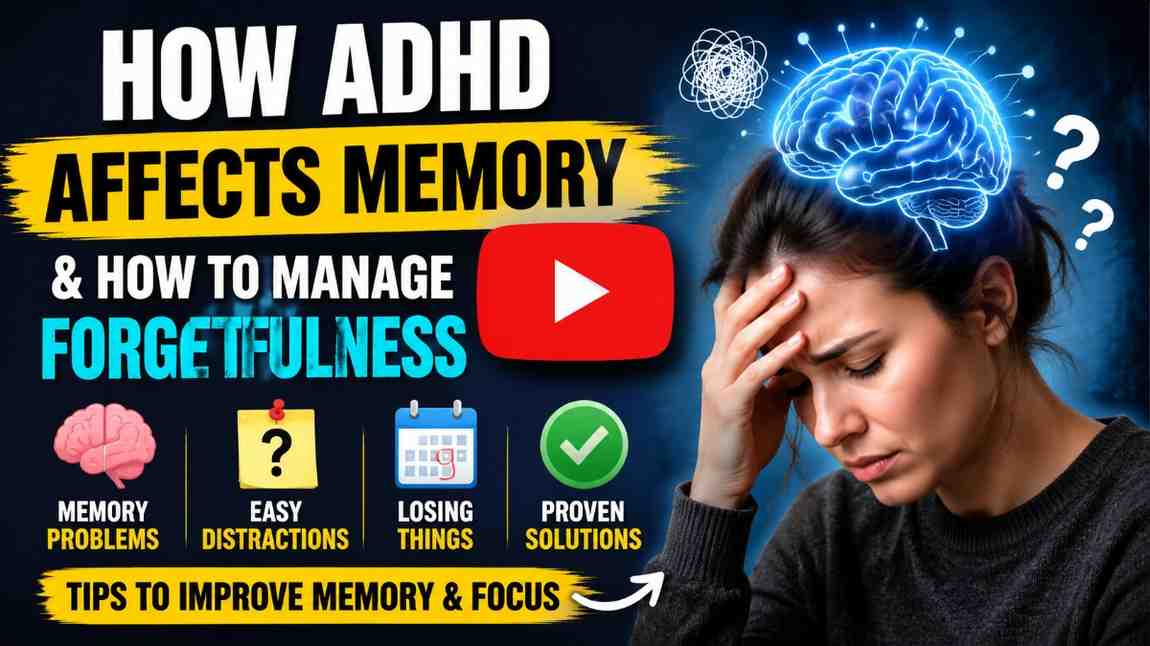

This article explores how ADHD affects memory systems, why forgetfulness occurs so frequently, and practical, science-based strategies to manage it effectively.
Understanding Memory Systems in ADHD
Memory is not a single ability but a combination of interconnected systems that include working memory, short-term memory, and long-term memory. Each plays a different role in how information is processed and stored.
Working memory is the most affected in ADHD. It allows the brain to temporarily hold information while simultaneously using it for tasks such as following instructions, solving problems, or organizing steps in a sequence.
In ADHD, this system often becomes overloaded or unstable due to attention fluctuations.
Short-term memory holds information for brief periods, but without strong attention, the information may never be fully encoded. Long-term memory stores information more permanently, but its effectiveness depends on how well information is initially processed.
Research indicates that individuals with ADHD show consistent difficulties in working memory performance, which directly impacts learning, organization, and daily task completion.
When working memory is weak, even simple tasks can become overwhelming because the brain struggles to retain multiple pieces of information at once.
Why ADHD Leads to Frequent Forgetfulness
Forgetfulness in ADHD is not random; it is the result of how attention and memory systems interact.
One of the primary causes is inconsistent attention during information encoding. If attention shifts away even briefly, the brain may fail to fully register what is being learned or experienced.
Another key factor is distractibility. The ADHD brain is highly sensitive to internal thoughts and external stimuli.
This constant switching of focus interferes with memory formation, as the brain cannot maintain stable attention long enough to encode information effectively.
Additionally, executive function deficits contribute to poor organization of information. Even when information is stored, it may not be structured properly, making retrieval difficult later.
This is why individuals with ADHD often feel like they “know” something but cannot recall it at the right moment.
Stress and emotional overload can also worsen forgetfulness. When the brain is emotionally overwhelmed, cognitive resources are redirected away from memory processing, further reducing recall ability.
The Role of Working Memory in Daily Functioning
Working memory is essential for nearly every daily task. It helps you remember what you are doing while doing it. In ADHD, working memory limitations can create a wide range of challenges.
For example, following multi-step instructions becomes difficult because earlier steps are forgotten before the task is completed.
Conversations may be hard to follow because attention drifts, causing gaps in understanding. Academic and workplace tasks that require sustained mental effort may feel exhausting or disorganized.
Common real-life examples include:
- Forgetting why you walked into a room
- Losing track of conversations mid-sentence
- Forgetting appointments or deadlines
- Misplacing essential items like keys or phones
- Difficulty completing multi-step tasks without reminders
Studies show that working memory deficits are one of the most reliable cognitive markers in ADHD, affecting both children and adults.
These deficits are not due to lack of effort but reflect differences in how the brain temporarily stores and processes information.
ADHD and the Difference Between Memory Types
ADHD does not affect all memory systems equally. Understanding this distinction is important for reducing confusion and self-blame.
Short-term memory is often inconsistent in ADHD because attention is unstable. If focus shifts during the moment of encoding, the information may never fully enter memory storage.
Working memory is the most significantly affected system. It is responsible for holding and manipulating information in real time. When this system is overloaded, even simple mental tasks become difficult.
Long-term memory, however, is often relatively intact.
Many individuals with ADHD can recall detailed past experiences, facts, or emotionally significant events. The challenge is not storing information long-term but successfully transferring it there in the first place.
This explains why someone with ADHD may forget small daily tasks but vividly remember meaningful life events.
How ADHD Affects Learning and Information Retention
In learning environments, ADHD-related memory challenges become especially noticeable. Students may understand material during class but struggle to retain it later because attention was inconsistent during instruction.
This leads to incomplete encoding of information. Even if the material was heard, it may not have been processed deeply enough for long-term retention. Repetition and reinforcement become essential for strengthening memory pathways.
Similarly, in workplace settings, instructions given verbally may be forgotten quickly if not written down. Tasks that rely heavily on working memory, such as managing multiple responsibilities simultaneously, become more difficult.
This does not reflect an inability to learn but rather the need for structured learning methods that support attention and repetition.

Emotional Impact of ADHD Forgetfulness
The emotional consequences of ADHD-related forgetfulness are often underestimated. Repeated memory lapses can lead to frustration, embarrassment, and reduced self-confidence.
Many individuals begin to internalize forgetfulness as a personal flaw, which can contribute to anxiety or low self-esteem.
Over time, this emotional burden can worsen attention difficulties, creating a cycle of stress and cognitive overload.
In relationships, forgetfulness may be misunderstood as a lack of care or interest. This can lead to misunderstandings, even though the underlying issue is neurological.
Recognizing that forgetfulness is a symptom of ADHD, not a personality trait, is essential for reducing emotional distress and improving coping strategies.
Evidence-Based Strategies to Manage ADHD Forgetfulness
While ADHD-related memory challenges cannot be eliminated, they can be effectively managed through structured techniques.
External Memory Systems
Using external tools such as calendars, reminders, notes, and alarms helps reduce reliance on working memory. Writing things down ensures information is stored outside the brain.
Routine-Based Living
Consistent routines reduce the need for memory recall. When actions become habitual, the brain relies less on active working memory.
Task Simplification
Breaking large tasks into smaller steps reduces cognitive overload and improves completion rates.
Environmental Organization
Keeping items in fixed, predictable locations reduces memory strain and minimizes daily forgetfulness.
Repetition and Reinforcement
Repetition strengthens neural pathways and improves retention. Reviewing information multiple times increases the likelihood of long-term storage.
Mindful Attention Training
Practices such as mindfulness help improve focus stability, which indirectly strengthens memory encoding.
Professional Support
Behavioral therapy, coaching, and in some cases medication can improve attention regulation, which significantly enhances memory performance.
Cognitive Mechanisms Behind ADHD Memory Challenges
From a neurological perspective, ADHD is associated with differences in brain networks responsible for attention regulation and executive function.
The prefrontal cortex, which plays a central role in working memory and decision-making, often shows reduced efficiency in coordination.
Dopamine regulation also plays a key role. Dopamine is involved in motivation and attention control, and imbalances can affect how consistently the brain maintains focus. When attention fluctuates, memory encoding becomes unreliable.
This means that forgetfulness in ADHD is not a storage failure but a processing and attention regulation issue. The brain may receive information but fail to stabilize it long enough for proper encoding.
Improving Daily Life with ADHD Memory Challenges
Living with ADHD-related forgetfulness requires designing systems that support natural cognitive patterns rather than fighting against them. External structure becomes a form of cognitive support.
Simple adjustments such as using visual cues, maintaining consistent routines, and reducing unnecessary multitasking can significantly improve daily functioning. Over time, these systems reduce stress and improve independence.
Importantly, success in managing ADHD forgetfulness is not about perfect memory but about building reliable external supports that compensate for working memory limitations.
ADHD in Adults vs Children: Memory Differences
In children, ADHD-related forgetfulness is often observed in school performance, homework completion, and following instructions. Teachers may notice inconsistent performance despite understanding the material.
In adults, forgetfulness often manifests in workplace organization, time management, and personal responsibilities.
Missed deadlines, forgotten appointments, and difficulty managing multiple tasks are common challenges.
While the underlying mechanism remains the same, the impact shifts depending on life demands. Adults often develop coping strategies over time, but without structured support, challenges may persist.
Conclusion
ADHD significantly affects memory, particularly through its impact on attention regulation and working memory.
Forgetfulness in ADHD is not a sign of poor intelligence or lack of effort, but a result of how the brain processes, encodes, and retrieves information.
When attention is unstable, memory formation becomes inconsistent, leading to everyday challenges in learning, organization, and task completion.
However, these challenges can be effectively managed. With structured routines, external memory tools, repetition strategies, and attention-supporting techniques, individuals with ADHD can greatly reduce forgetfulness and improve daily functioning.
Understanding the neurological basis of ADHD is key to removing stigma and building practical systems that support cognitive strengths.
Ultimately, success is not about eliminating forgetfulness entirely but about creating environments and habits that allow the ADHD brain to function more efficiently and confidently in everyday life.
References
- https://en.wikipedia.org/wiki/Attention_deficit_hyperactivity_disorder
- https://www.healthline.com/health/adhd/adhd-memory
- https://www.webmd.com/add-adhd/adult-adhd-memory-loss
.
About Us