10 Proven Mnemonics to Boost Your Memory Skills Fast
10 Proven Mnemonics to Boost Your Memory Skills
Memory plays a powerful role in everything we learn, from remembering names and dates to mastering complex subjects like science, language, and medicine.
Yet, many people struggle with retention because the brain naturally forgets information that isn’t reinforced or meaningfully encoded.
This is where mnemonic techniques come in. Mnemonics are proven memory tools that help you convert difficult or abstract information into simple, memorable patterns, stories, or associations.
Research shows that mnemonic strategies can significantly improve recall and learning efficiency by strengthening the brain’s encoding and retrieval of information.


In this detailed guide, we’ll explore 10 powerful and proven mnemonics that can dramatically improve your memory skills and help you learn faster, retain longer, and recall information more confidently.
1. Acronyms – Turn Information Into Easy Words
Acronyms help you convert long lists of information into a single easy-to-remember word by using the first letters of each item. This simplifies complex data and makes recall faster and more efficient. It is especially useful for exams, formulas, and structured information.
For example:
- ROYGBIV → colors of the rainbow
- HOMES → Great Lakes (Huron, Ontario, Michigan, Erie, Superior)
Acronyms simplify long lists into one easy-to-remember word, making them ideal for exams, presentations, and daily recall tasks.
2. Acrostics – Make Sentences From First Letters
Acrostics transform the first letters of a list into a meaningful sentence that is easier for the brain to remember. Since sentences are naturally easier to recall than random words, this method strengthens memory retention. It is widely used in education for learning sequences and lists.
Example:
- “My Very Educated Mother Just Served Us Nachos” → planets of the solar system
Each word in the sentence represents a concept you need to remember. Because sentences are easier for the brain to process, acrostics are extremely effective for long-term retention.
3. Method of Loci – The Memory Palace Technique
The Method of Loci involves placing information in specific locations within a familiar mental space, like your home. By mentally walking through this “memory palace,” you can easily recall stored information. This technique is powerful for remembering large amounts of structured data.
For example:
- Place grocery items in different rooms of your house
- Walk through your house mentally to recall them
This spatial memory technique is widely used by memory champions and is especially effective for remembering large amounts of structured information.
4. Chunking – Break Big Information Into Small Pieces
Chunking works by dividing large pieces of information into smaller, meaningful groups. The brain processes grouped data more efficiently than long, unorganized strings. It is commonly used for remembering phone numbers, passwords, and complex study material.
Example:
- Phone number: 9876543210
- Chunked: 987-654-3210
Your brain naturally remembers grouped information better than long strings of data. Chunking is commonly used in phone numbers, credit cards, and study notes.
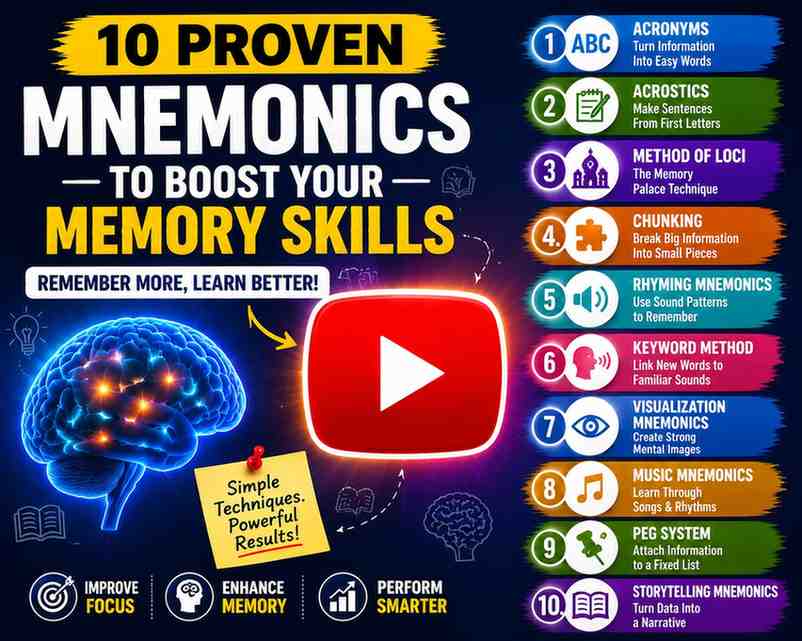
5. Rhyming Mnemonics – Use Sound Patterns to Remember
Rhyming mnemonics use rhythm and sound patterns to make information catchier and more memorable. The brain naturally remembers rhythmic phrases better than plain facts. This method is often used in rules, spelling, and early education.
Example:
- “I before E except after C”
Rhyming mnemonics are widely used in education because they turn complex rules into simple, musical patterns that stick in memory.
6. Keyword Method – Link New Words to Familiar Sounds
The keyword method connects unfamiliar words to similar-sounding familiar words and helps create a mental image. This combination of sound and visualization strengthens memory encoding. It is especially effective for learning new languages and vocabulary.
Example:
- Spanish “gato” (cat) → imagine a cat on a gate
This visual-auditory link strengthens recall and makes vocabulary learning much easier.
7. Visualization Mnemonics – Create Strong Mental Images
Visualization mnemonics rely on forming vivid and often exaggerated mental images to represent information. The more unusual or emotional the image, the easier it becomes to remember. This technique is powerful for both short-term and long-term recall.
Example:
- To remember “apple,” imagine a giant glowing apple floating in the sky
The more unusual or emotional the image, the easier it is for your brain to recall it later. This method is highly effective for both students and professionals.
8. Music Mnemonics – Learn Through Songs and Rhythms
Music mnemonics use melodies, rhythm, and songs to encode information into memory. Since the brain naturally remembers music easily, it becomes a strong tool for learning sequences and facts. This method is commonly used in educational songs and learning aids.
Examples include:
- Alphabet song (A-B-C-D…)
- Educational songs for multiplication tables
Even complex information becomes easier when set to music. That’s why children and adults alike remember songs effortlessly.
9. Peg System – Attach Information to a Fixed List
The peg system uses a pre-memorized list, such as numbers or rhyming words, as anchors to attach new information. Each item is linked to a “peg,” making recall structured and sequential. It is especially useful for memorizing ordered lists.
Example peg list:
1 = Bun
2 = Shoe
3 = Tree
4 = Door
If you want to remember grocery items:
- Milk → imagine milk spilling on a bun
- Eggs → smashed inside a shoe
This creates structured recall pathways for ordered information.
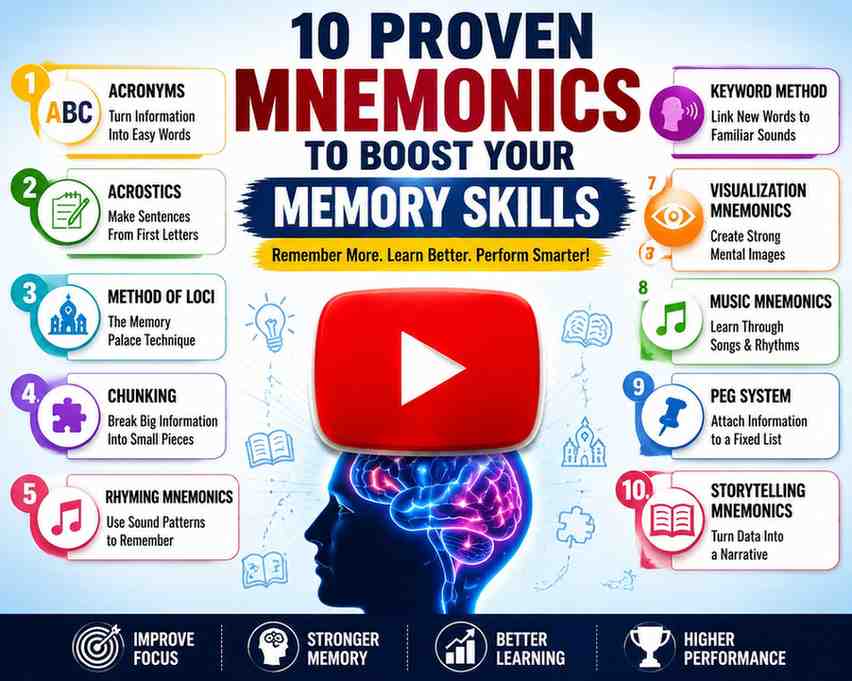
10. Storytelling Mnemonics – Turn Data Into a Narrative
Storytelling mnemonics connect separate pieces of information into a continuous story. Since the brain naturally remembers narratives better than isolated facts, this method improves recall. It is highly effective for exams, presentations, and complex topics.
Example:
Instead of remembering unrelated words like “dog, book, car,” create a story:
- A dog reads a book inside a car
The brain recalls sequences better when they are connected through imagination and emotion.
Why Mnemonics Work So Effectively
Mnemonics work because they transform abstract or complex information into meaningful patterns, images, or associations. This strengthens encoding in the brain and improves retrieval speed. They also engage imagination, emotion, and logic, making memory more durable.
- Create strong mental associations
- Convert abstract data into meaningful patterns
- Engage imagination and emotions
- Improve encoding and retrieval processes
Research in cognitive science shows that mnemonic techniques significantly enhance learning performance and long-term recall.
How to Choose the Right Mnemonic Technique
- For lists → Acronyms, chunking, peg system
- For language learning → Keyword method
- For exams → Acrostics, storytelling
- For visual learners → Visualization, memory palace
- For auditory learners → Rhymes, music
Combining multiple techniques often produces even stronger memory performance.
Tips to Maximize Your Memory Skills
- Practice mnemonics regularly, not just during exams
- Make images exaggerated and emotional
- Use personal experiences in your mnemonics
- Repeat and review often
- Combine techniques for better retention
Consistency is key to developing strong memory skills.
Final Thoughts
Mnemonics are not just study tricks—they are powerful cognitive tools that can reshape how your brain processes and retains information.
By using techniques like acronyms, visualization, storytelling, and memory palaces, you can dramatically improve your ability to learn and remember.
With regular practice, these 10 proven mnemonics can help you transform your memory skills, boost academic performance, and increase everyday cognitive efficiency.
📚 Reference
About Us