Hume Band 2.0 Blood Pressure Accuracy Test: Full 2026 Review
Wearable health technology has moved far beyond counting steps. Modern devices can track heart rate, sleep, recovery, blood oxygen, skin temperature, heart-rate variability, and increasingly, blood-pressure-related patterns.
The Hume Band 2.0 Blood Pressure Accuracy Test is therefore becoming an important topic for people who want to know whether the numbers and trends displayed on their wrist can actually be trusted.
The Hume Band 2.0 is designed primarily as a wellness and longevity tracker. One of its newest and most interesting capabilities is blood-pressure trend insight, which uses optical wrist sensors to observe physiological signals over time.
Hume Band 2.0 tracks blood pressure trends using optical sensors, helping users compare daily patterns with readings from a validated upper-arm cuff.
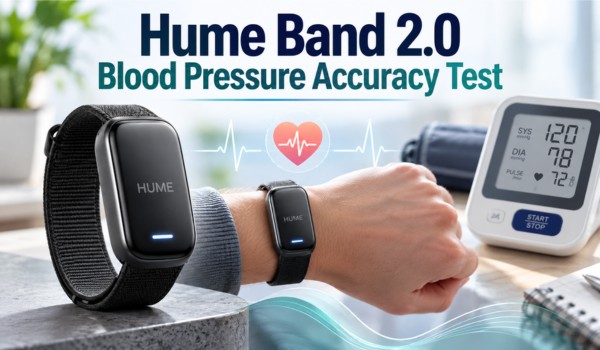
Unlike a traditional upper-arm blood pressure cuff, however, the Hume Band does not inflate around an artery and directly perform a conventional oscillometric blood-pressure measurement. That distinction matters.
Hume currently describes its blood-pressure feature as a way to follow relative patterns and directional changes, rather than as a replacement for a medically validated blood pressure cuff.
This makes the feature potentially useful for understanding how sleep, stress, physical activity, diet, recovery, and everyday habits may correspond with cardiovascular trends.
But how close can a Hume Band 2.0 reading come to an actual upper-arm cuff? What affects its accuracy? And how should someone perform a fair Hume Band 2.0 Blood Pressure Accuracy Test at home?
This detailed guide explains what we currently know, how the technology works, how to compare the Band against a traditional monitor, and what the results really mean.
Quick Answer: Is Hume Band 2.0 Blood Pressure Accurate?
Yes, the Hume Band 2.0 can provide useful, encouraging blood pressure trend insights when worn correctly and used consistently.
Its optical sensor system tracks cardiovascular patterns throughout the day, helping users understand how readings may change with sleep, activity, recovery, stress, and daily habits.
The Band is especially helpful for people who want continuous wellness data instead of relying only on occasional measurements. Proper fit, stable wrist placement, and regular use can support more consistent trend tracking over time.
For the strongest overall monitoring approach, users can regularly compare Hume Band trends with readings from a validated upper-arm blood pressure monitor.
This combination offers convenient daily awareness, meaningful long-term patterns, and a reliable reference point for important blood pressure checks and informed health conversations with healthcare professionals.
✅ Click to Buy Hume Band at a Discounted Price!
What Is the Hume Band 2.0?
The Hume Band 2.0 is a screen-free wearable designed to monitor several health and recovery signals throughout the day and night. Instead of constantly displaying notifications on the wrist, the Band collects information, and the Hume Health app interprets it.
The device tracks metrics that may include heart rate, heart-rate variability, resting heart rate, blood oxygen, sleep stages, recovery, activity, strain, skin temperature, steps, calories, and blood-pressure-related trends.
One notable hardware upgrade is its optical sensing system. Hume states that the Band 2.0 uses five LEDs and four photodiodes to collect physiological signals from the wrist.
The device is designed for long-term wear rather than occasional spot measurements. Hume advertises up to 14 days of battery life, letting users collect more continuous data without removing the Band every night for charging.
For blood pressure specifically, this continuous-wear approach may help for spot trends because blood pressure isn’t a fixed number. It changes throughout the day according to activity, sleep, stress, hydration, caffeine, medication, meals, body position, and many other factors.
How Does Hume Band 2.0 Estimate Blood Pressure?
Understanding the Hume Band 2.0 Blood Pressure Accuracy Test starts with what happens under the wearable. Traditional blood-pressure monitors normally use an inflatable cuff.
The cuff temporarily compresses an artery, and the monitor analyzes pressure changes as the cuff deflates. Researchers have studied and standardized this method extensively.
A wearable like the Hume Band takes a different approach. Hume states that its blood-pressure insights are based on photoplethysmography, or PPG.
PPG is an optical sensing technique. LEDs shine light into the tissue beneath the wearable, while photodiodes detect changes in reflected light. Because blood volume changes with every heartbeat, the returned light signal contains information about the pulse waveform.
Advanced software can analyze characteristics of that waveform alongside other physiological information. Algorithms can then look for patterns associated with changes in cardiovascular behavior. This is why wearable blood-pressure technology is often described as an indirect estimation method.
The Band does not squeeze the arm and directly recreate the measurement process used by a conventional cuff. Instead, it interprets physiological signals associated with blood flow. That makes consistent sensor contact, good positioning, limited movement, and reliable signal quality particularly important.
✅ Click to Try Hume Band 2.0 Today
Hume Band 2.0 Measures Trends Rather Than Replacing a Cuff
One of the most important things to understand about the Hume Band 2.0 is how the manufacturer currently describes its blood-pressure functionality.
Hume’s current product information calls the feature blood-pressure trend insights and explicitly describes it as a directional pattern rather than a diagnosis or replacement for an arm cuff. This distinction actually helps explain the most sensible way to use the feature.
Imagine that your validated upper-arm cuff gives readings around the same range most mornings. Meanwhile, the Hume app begins showing that your blood-pressure-related pattern is gradually moving upward during a stressful week with poor sleep.
Even if the wearable doesn’t match your cuff measurement millimeter for millimeter, recognizing a meaningful directional change may still encourage you to check your blood pressure properly.
That type of pattern awareness is where cuffless wearable technology may eventually prove most valuable.
Hume Band 2.0 Blood Pressure Accuracy Test: The Best Testing Method
A proper comparison requires more than taking one reading from the Hume Band and immediately comparing it with a random blood-pressure monitor.
Blood pressure naturally fluctuates from minute to minute. Posture, movement, talking, temperature, stress, caffeine, exercise, meals, and even a full bladder can alter the result.
A more useful Hume Band 2.0 Blood Pressure Accuracy Test should compare measurements repeatedly under standardized conditions.
| Test Stage | Recommended Approach |
|---|---|
| Reference device | Use a validated automatic upper-arm monitor |
| Environment | Sit in a quiet, comfortable room |
| Rest period | Rest quietly for approximately five minutes |
| Body position | Sit upright with back supported |
| Feet | Keep both feet flat on the floor |
| Legs | Avoid crossing your legs |
| Arm | Support the arm around heart level |
| Band position | Wear securely with good skin contact |
| Movement | Remain still during measurement |
| Talking | Avoid conversation while testing |
| Reference readings | Take multiple cuff readings |
| Test duration | Repeat comparisons across several days |
| Evaluation | Compare overall trends, not one isolated result |
Testing over several days provides a much more realistic picture than judging the wearable after one comparison.
Step 1: Choose a Reliable Upper-Arm Blood Pressure Monitor
Choose a validated upper-arm blood pressure monitor with a properly fitted cuff to create a dependable reference for comparison. A reliable monitor provides a strong foundation for understanding and evaluating your Hume Band’s blood-pressure trend insights.
Step 2: Prepare Properly Before Testing
Before testing, sit comfortably, relax for a few minutes, keep your feet flat, and support your back. Consistent preparation creates reliable readings and helps make your comparison with the Hume Band more meaningful.
Step 3: Wear the Hume Band Correctly
Wear the Hume Band securely and comfortably so its sensors maintain consistent contact with your skin. Keeping the Band in a similar position during each test can support stable readings and useful trend information.
Step 4: Take Multiple Cuff Measurements
Take two or three readings with your upper-arm monitor and record the results to create a clearer reference point. Multiple measurements can provide a more representative view of your blood-pressure levels for comparison.
Step 5: Compare the Hume Trend With the Reference Reading
Compare the overall direction of your Hume Band’s blood-pressure trends with the readings from your reference monitor. Looking at whether both follow similar upward or downward patterns can help you understand changes over time.
Step 6: Repeat the Accuracy Test for Seven Days
Repeat your measurements at consistent times for approximately seven days to build a broader picture of your blood-pressure patterns. Consistent observations can make the comparison more informative and help you recognize longer-term trends.

Example of a Seven-Day Accuracy Comparison
The following table is an illustrative example only. These are not claimed Hume Band clinical-validation results.
| Day | Validated Cuff | Wearable Trend | General Agreement |
|---|---|---|---|
| Monday | 122/78 | Similar range | Close |
| Tuesday | 124/80 | Slight increase | Similar direction |
| Wednesday | 128/82 | Increasing | Similar direction |
| Thursday | 126/80 | Slight decline | Similar direction |
| Friday | 130/84 | Increasing | Similar direction |
| Saturday | 123/79 | Declining | Similar direction |
| Sunday | 121/77 | Lower | Similar direction |
The objective isn’t merely to ask whether every number matches. A more meaningful question is whether the wearable reliably captures changes and patterns.
What Has Independent Hume Band 2.0 Testing Found?
Independent Hume Band 2.0 testing suggests that its blood pressure feature can provide useful trend-based insights when compared with a traditional upper-arm cuff.
In one hands-on comparison, the systolic reading was very close to the cuff result, while the diastolic reading differed more. This suggests the
Band may be more useful for observing general blood pressure patterns than for expecting identical medical-grade readings. More independent and large-scale testing is still needed to fully confirm its accuracy across different users.
- Close Systolic Result: Some tests showed only a small difference compared with an upper-arm cuff.
- Diastolic Variation: Lower-pressure readings may vary more between devices.
- Useful for Trends: Best suited for monitoring changes and patterns over time.
- Not a Cuff Replacement: Confirm important readings with a validated upper-arm monitor.
- More Testing Needed: Larger independent studies would provide stronger evidence of overall accuracy.
Why Systolic and Diastolic Accuracy May Differ
Systolic and diastolic blood pressure represent different stages of the heartbeat, so wearable estimates may not match both values equally.
Systolic pressure measures the force when the heart contracts, while diastolic pressure reflects pressure between beats. Cuffless devices rely on optical signals and algorithms rather than direct cuff pressure,
which can create differences between the two readings. Individual circulation, movement, sensor contact, and body position may also affect how accurately each value is estimated.
- Systolic Pressure: Measures pressure during heart contraction.
- Diastolic Pressure: Measures pressure while the heart relaxes.
- Different Signals: Algorithms may estimate each value differently.
- User Factors: Circulation and sensor fit can affect results.
- Trend Focus: Overall patterns may be more useful than exact matching.
What Research Says About Cuffless Blood Pressure Technology
Research on cuffless blood pressure technology shows promising potential for convenient, continuous cardiovascular monitoring.
Many modern devices use PPG, pulse-wave analysis, or combinations of optical and electrical signals to estimate blood pressure without an inflatable cuff.
Some studies have reported encouraging results under controlled conditions, especially when devices are properly calibrated and positioned.
However, researchers continue to emphasize the need for device-specific validation before cuffless wearables can replace standard clinical monitors.
- Growing Research: Cuffless blood pressure monitoring is being widely studied.
- Optical Sensors: PPG is one of the most common technologies used.
- Promising Results: Some devices perform well in controlled studies.
- Calibration Matters: Proper setup can influence measurement quality.
- More Validation Needed: Results from one device cannot validate another.
✅ Click to Buy Hume Band at a Discounted Price!
Why Formal Validation Is Different From a Home Accuracy Test
Formal validation is much more detailed than comparing a wearable with a home blood pressure cuff once or twice. Clinical studies use standardized protocols, trained professionals, reference equipment, multiple participants, and carefully controlled testing conditions.
Researchers also analyze average measurement differences and consistency across many blood pressure ranges. A home accuracy test can still be useful for personal comparison, but it cannot prove that a device meets recognized medical accuracy standards.
- Controlled Testing: Formal studies follow standardized procedures.
- Larger Groups: Validation includes many different participants.
- Reference Devices: Researchers compare results with trusted equipment.
- Statistical Review: Researchers assess accuracy across repeated measurements.
- Home Tests: Helpful for personal comparison, not clinical validation.
Factors That Can Affect Hume Band 2.0 Blood Pressure Accuracy
Several variables may influence cuffless wearable readings.
| Factor | Potential Effect |
|---|---|
| Loose Band | Poor optical sensor contact |
| Excessive tightness | May affect comfort and local circulation |
| Wrist movement | Adds noise to optical signals |
| Exercise | Temporarily changes cardiovascular measurements |
| Stress | Can increase blood pressure and heart rate |
| Cold skin | May reduce peripheral blood flow |
| Poor positioning | Can reduce sensor consistency |
| Sweat or moisture | May interfere with stable contact |
| Different test times | Natural daily BP changes become a factor |
| Poor sleep | Can influence cardiovascular patterns |
| Alcohol | May alter cardiovascular measurements |
| Caffeine | Can temporarily increase blood pressure |
| Medications | Can significantly change blood pressure |
| Individual physiology | Algorithms may perform differently among users |
These factors explain why repeatability matters.
Can Movement Affect the Home Blood Pressure Reading?
Yes, body and wrist movement can influence blood pressure readings because accurate monitoring works best when the body is calm and properly positioned.
Staying still helps both traditional monitors and optical wearable sensors capture a cleaner, more consistent cardiovascular signal. For the Hume Band 2.0, stable wrist positioning can support stronger contact between the optical sensors and the skin.
Resting quietly before comparing readings also creates a more consistent environment for an accuracy test. Following the same routine each time can make blood pressure trends easier to understand and compare.
- Stay Still: Helps produce cleaner measurement signals.
- Rest First: Sit calmly before checking blood pressure.
- Avoid Talking: Quiet measurement improves consistency.
- Stable Wrist: A stable wrist supports reliable optical sensor contact.
- Repeat Conditions: Use the same routine for comparisons.
Does Band Position Matter?
Yes, proper Band position plays an important role in helping the Hume Band 2.0 collect consistent optical signals. The sensors work best when they maintain comfortable and steady contact with the skin throughout monitoring.
Wearing the Band securely reduces unnecessary movement and helps the LEDs and photodiodes capture clearer pulse information. Using approximately the same wrist position every day also improves consistency when comparing long-term trends. A comfortable, secure fit therefore supports the Band’s ability to provide useful wellness insights.
- Secure Fit: Keeps the optical sensors close to the skin.
- Good Contact: Supports stronger PPG signal collection.
- Same Position: Makes day-to-day trends easier to compare.
- Comfortable Wear: Encourages consistent daily monitoring.
- Stable Placement: Helps maintain dependable signal quality.
Can Skin Temperature Affect Optical Readings?
Skin temperature can influence optical measurements because circulation near the surface of the skin naturally changes with temperature.
Comfortable skin temperature generally supports stronger peripheral blood flow and gives optical sensors favorable conditions for detecting pulse-related changes.
The Hume Band 2.0 also monitors skin-temperature trends as part of its broader wellness-tracking system. Allowing the body to return to a comfortable temperature after exposure to very hot or cold conditions can improve consistency. This simple approach can make repeated wearable comparisons more meaningful.
- Comfortable Temperature: Supports stable peripheral circulation.
- Warm-Up Period: Allow the wrist to normalize after cold exposure.
- Consistent Conditions: Improve day-to-day comparisons.
- Optical Signals: Good circulation can support signal detection.
- Trend Awareness: Temperature provides useful physiological context.
How Accurate Should a Blood Pressure Monitor Be?
A good blood pressure monitor should provide dependable, repeatable results when used correctly under standardized conditions. Evaluate accuracy across multiple readings rather than judging a device by a single measurement.
Clinically validated upper-arm monitors remain an excellent reference when testing or confirming blood pressure measurements at home.
Wearables such as the Hume Band can add value by showing patterns and changes across longer periods. Using both approaches together can provide a broader picture of cardiovascular wellness while maintaining reliable reference measurements.
- Consistency Matters: Look for repeatable measurements.
- Multiple Readings: Offer a stronger comparison than a single test.
- Upper-Arm Reference: Useful for confirming important numbers.
- Wearable Trends: Add convenient long-term health context.
- Combined Approach: Offers both measurements and daily patterns.
✅ Click to Buy Hume Band at a Discounted Price!
Is Hume Band 2.0 FDA Approved for Blood Pressure?
Interpret current Hume information carefully because its official pages use different descriptions of the blood pressure feature. One Hume page states that blood pressure is planned for a future app.
One page says the feature is pending FDA approval, while another presents PPG-based blood-pressure trend insights as directional wellness information rather than a medical device.
The positive takeaway is that Hume clearly distinguishes its trend feature from a traditional diagnostic blood pressure cuff. This transparent positioning lets users gain
Additional cardiovascular awareness without treating the wearable as a replacement for clinical equipment. For medical measurements, users can pair Hume’s trend information with an appropriately authorized upper-arm monitor.
- Trend Focus: Designed to highlight changing patterns over time.
- Clear Positioning: Hume describes trends as wellness insights.
- PPG Technology: Optical sensors support continuous monitoring.
- Complementary Use: Works alongside conventional BP monitoring.
- Growing Capability: Reflects continued innovation in wearable health technology.
What Does the FDA Say About Wearable Blood Pressure Devices?
The FDA recognizes that wearable technology is rapidly expanding the possibilities for convenient cardiovascular monitoring. Its guidance emphasizes
the Importance of using properly authorized blood pressure devices when accurate measurements are needed for medical care.
This approach encourages wearable manufacturers to demonstrate strong safety, effectiveness, and measurement performance before making medical blood pressure claims.
For consumers, FDA authorization provides an additional level of confidence when choosing equipment for clinical blood pressure decisions.
Wearables can still provide valuable wellness information while users confirm medically important readings with an authorized device.
- Safety First: FDA guidance prioritizes dependable measurements.
- Authorization Matters: Medical BP devices should meet regulatory requirements.
- Innovation Supported: Wearable health technology continues to advance.
- Consumer Confidence: Evaluation helps users select suitable devices.
- Smart Combination: Wellness wearables can complement authorized monitors.
What Does the American Heart Association Say?
The American Heart Association recognizes the strong potential of cuffless blood pressure technology to expand how cardiovascular information is collected throughout everyday life.
Wearables may eventually make it easier to observe blood pressure patterns during sleep, daily activities, and other situations where traditional cuff measurements are inconvenient.
The AHA encourages continued research, standardized validation, and improved real-world testing so these technologies can reach their full potential.
For accurate hypertension diagnosis and treatment decisions today, the organization continues to support validated cuff-based home monitoring.
This creates a practical approach in which innovative wearable trends can complement established blood pressure measurements.
- Promising Technology: Cuffless monitoring has significant future potential.
- Continuous Insights: Wearables can collect information throughout daily life.
- More Research: Strong validation can expand future clinical applications.
- Home Monitoring: Validated cuffs remain an important reference.
- Complementary Tracking: Wearables can add valuable long-term context.
Hume Band 2.0 vs Upper-Arm Blood Pressure Monitor
| Feature | Hume Band 2.0 | Validated Upper-Arm Cuff |
|---|---|---|
| Measurement style | Cuffless optical trend estimation | Inflatable arm cuff |
| Technology | PPG-based wearable signals | Oscillometric measurement |
| Convenience | Excellent for continuous wear | Requires manual measurement |
| Trend tracking | Strong focus | Depends on monitor/app |
| Overnight wear | Convenient | Usually impractical |
| During daily life | Designed for ongoing tracking | Used periodically |
| Medical diagnosis | Not intended as replacement | Appropriate when validated |
| Medication decisions | Do not rely on Band alone | Preferred with medical guidance |
| Ease of use | Very convenient | Slightly more effort |
| Main strength | Pattern awareness | Accurate BP measurement |
The two products therefore serve different roles rather than being perfect substitutes.
Where Hume Band 2.0 May Be Most Useful
The Hume Band 2.0 may be most useful for people who want convenient, continuous insight into daily cardiovascular patterns. It can help users observe how sleep, stress, activity, recovery, and lifestyle habits may relate to blood pressure trends over time.
Because the Band is designed for regular wear, it can provide a broader picture than occasional spot checks alone. Its greatest value comes from helping users notice changes and build stronger awareness of their overall wellness patterns.
- Daily Tracking: Helps monitor ongoing cardiovascular trends.
- Lifestyle Insights: Connects patterns with sleep, stress, and activity.
- Continuous Wear: Provides information across longer periods.
- Trend Awareness: Makes changes easier to notice.
- Wellness Focus: Supports a more complete health-tracking routine.
When You Should Still Use a Traditional Blood Pressure Cuff
A traditional upper-arm blood pressure cuff remains the best choice when precise measurements are important for health decisions.
It is especially valuable for people managing hypertension, monitoring treatment, or confirming an unusual wearable reading. Using a validated cuff alongside.
Hume Band creates a strong combination of accurate spot measurements and convenient long-term trend tracking. This balanced approach allows users to benefit from wearable technology while maintaining dependable reference readings.
- Precise Readings: Ideal when exact measurements matter.
- Hypertension Monitoring: Useful for regular medical tracking.
- Reading Confirmation: Helps verify unusual wearable trends.
- Treatment Support: Appropriate for clinician-guided monitoring.
- Best Combination: Pair cuff readings with wearable insights.
How to Improve Hume Band 2.0 Blood Pressure Consistency
Consistent use can help improve the quality of Hume Band 2.0 blood pressure trend data. Wear the Band securely in the same position, maintain good sensor contact, and keep the sensor area clean and dry.
Comparing measurements under similar conditions and at similar times each day can also make trends easier to interpret. Regular wear allows the device to build a more complete picture of your daily cardiovascular patterns.
- Secure Fit: Keep sensors comfortably against the skin.
- Same Position: Wear the Band consistently on the wrist.
- Clean Sensors: Keep the optical contact area clear.
- Regular Timing: Compare trends under similar conditions.
- Daily Wear: Builds a stronger long-term data pattern.
Is a One-Point Difference Proof of Accuracy?
A one-point difference between the Hume Band and an upper-arm cuff can be encouraging, but one comparison alone does not prove overall accuracy.
Blood pressure naturally changes throughout the day, and two devices may occasionally produce nearly identical readings. A stronger assessment comes from comparing multiple measurements across several days under consistent conditions. Repeated close agreement provides much more useful information than a single impressive result.
- Encouraging Result: A small difference can be positive.
- One Test Is Limited: Accuracy needs repeated comparison.
- Natural Variation: Blood pressure changes throughout the day.
- Multiple Readings: Multiple readings provide stronger evidence of consistency.
- Trend Agreement: Long-term patterns are more meaningful.
What Would Strong Hume Band Blood Pressure Validation Look Like?
Strong validation would involve independent testing of the Hume Band 2.0 against recognized reference blood pressure measurements. The study should include many participants with different ages, body types, blood pressure ranges, and health backgrounds.
Researchers would compare repeated measurements using standardized testing methods and detailed statistical analysis. Positive results across a large and diverse group would provide stronger evidence for the Band’s blood pressure performance.
- Independent Testing: Adds greater credibility to results.
- Large Study Group: Provides broader performance data.
- Diverse Participants: Tests accuracy across different users.
- Standardized Methods: Keeps comparisons consistent.
- Repeated Results: Demonstrate dependable performance over time.
✅ Click to Buy Hume Band at a Discounted Price!
Hume Band 2.0 Blood Pressure Accuracy Test: Our Overall Assessment
The Hume Band 2.0 offers an innovative, convenient way to track blood pressure trends alongside other health and recovery metrics.
Its continuous-wear design makes it especially useful for users who want to understand long-term cardiovascular patterns rather than rely only on occasional measurements.
The feature works best as a wellness and trend-awareness tool when paired with a validated upper-arm monitor for important readings. Overall, the Hume Band 2.0 adds meaningful cardiovascular context to a broader daily health-tracking routine.
- Innovative Tracking: Adds blood pressure trends to wearable monitoring.
- Convenient Design: Supports regular day and night use.
- Long-Term Insights: Helps identify changing cardiovascular patterns.
- Complementary Tool: Works well alongside a validated cuff.
- Strong Wellness Value: Adds useful context to daily health data.
Who Should Consider Using Hume Blood Pressure Trends?
Hume blood pressure trends may be useful for adults who enjoy tracking their health, fitness, sleep, recovery, and daily wellness patterns.
The feature can be especially appealing to users who want convenient cardiovascular insights without performing frequent manual measurements throughout the day.
It may also help people understand how lifestyle habits correspond with changes in their overall wellness data. Users who enjoy data-driven health tracking may find the Band particularly valuable as part of a broader monitoring routine.
- Health-Conscious Adults: Useful for everyday wellness tracking.
- Fitness Users: Adds cardiovascular context to activity data.
- Sleep Trackers: Helps connect recovery and daily patterns.
- Trend-Focused Users: Ideal for people who enjoy long-term data.
- Wellness Enthusiasts: Fits naturally into a broader health routine.
Final Thoughts
The Hume Band 2.0 offers a convenient, modern way to track blood pressure trends as part of a broader daily wellness routine. Its lightweight design and continuous tracking.
Integration with other health metrics makes it especially useful for people who want a clearer picture of how their body responds to sleep, activity, recovery, and everyday habits.
While its blood pressure feature is best viewed as a trend-based wellness tool, it adds meaningful context that can encourage users to stay more engaged with their cardiovascular health.
When paired with a validated upper-arm monitor for key readings, the Hume Band 2.0 offers a practical, well-rounded tracking experience.
Overall, it is a valuable choice for users who appreciate wearable technology, long-term health insights, and easy access to personal wellness data.

Click to Learn More About Hume Band Tracker
About Us