Elaborative Rehearsal to Improve Long – Term Memory Guide
Elaborative Rehearsal to Improve Your Long-Term Memory
Memory is one of the most essential cognitive abilities that shapes how we learn, understand, and interact with the world. Whether you are a student trying to remember complex academic material, a professional learning new skills, or simply someone who wants to improve daily recall, understanding how memory works can make a significant difference.
One of the most powerful and scientifically supported techniques for improving long-term memory is elaborative rehearsal.
Unlike simple repetition, elaborative rehearsal helps your brain create meaningful connections between new information and existing knowledge.
This deeper level of processing is what allows information to move from short-term memory into long-term storage, where it becomes easier to retrieve later.


In this comprehensive guide, we will explore what elaborative rehearsal is, how it works in the brain, why it is more effective than rote memorization, and how you can apply it in real-life situations to dramatically improve your memory performance.
What Is Elaborative Rehearsal?
Elaborative rehearsal is a cognitive learning strategy in which new information is actively connected to existing knowledge in memory. Instead of repeating information mechanically, you think about its meaning, relate it to what you already know, and create associations that make it more memorable.
In simple terms, it is the difference between memorizing facts and understanding them deeply.
For example:
- Instead of memorizing that “520 is an area code,” you might connect it to a memory of someone from Arizona and associate that location with the number.
- Instead of repeating a definition over and over, you think about how it applies in real life or how it connects to concepts you already understand.
This process enhances memory encoding, making information more meaningful and easier to retrieve later.
How Elaborative Rehearsal Works in the Brain
To understand why elaborative rehearsal is so effective, it is helpful to look at how memory formation works.
When new information enters the brain, it first passes through short-term (working) memory, which has limited capacity. Without proper encoding, this information is quickly forgotten.
Elaborative rehearsal strengthens memory by:
1. Deep Processing of Information
Instead of focusing on surface features like sound or repetition, elaborative rehearsal encourages semantic processing—thinking about meaning, relationships, and context.
2. Creating Associations
The brain stores information more effectively when it is linked to existing knowledge networks. These associations act as retrieval pathways, making it easier to access information later.
3. Strengthening Neural Connections
Repeated meaningful engagement strengthens synaptic connections between neurons. This increases the likelihood that the information will be stored in long-term memory.
4. Reducing Forgetting
Because the information is encoded in multiple ways (meaning, emotion, context), it becomes more resistant to forgetting over time.
Research in cognitive psychology consistently shows that deeper, meaningful processing leads to better long-term retention than shallow repetition.
Elaborative Rehearsal vs. Maintenance Rehearsal
To fully appreciate the power of elaborative rehearsal, it is important to compare it with maintenance rehearsal.
Maintenance rehearsal is simple repetition—like repeating a phone number until you dial it. It keeps information active in short-term memory but does not promote long-term retention.
Elaborative rehearsal, on the other hand, involves understanding and connecting information to existing knowledge structures.
Key Differences
- Maintenance Rehearsal: Repetition without meaning, short-term retention
- Elaborative Rehearsal: Meaning-based processing, long-term retention
Studies show that elaborative rehearsal is significantly more effective because it promotes deep encoding, which is essential for long-term memory storage.
Why Elaborative Rehearsal Improves Long-Term Memory
The effectiveness of elaborative rehearsal is explained by the levels of processing theory, which suggests that information processed deeply is remembered better than information processed superficially.
Here’s why it works so well:
1. Meaningful Encoding
When you understand something, your brain assigns meaning to it, making it easier to remember.
2. Multiple Retrieval Paths
Each association you create becomes a pathway to retrieve the information later.
3. Stronger Memory Traces
Deep processing creates richer and more distinct memory traces in the brain.
4. Better Organization of Knowledge
New information is not stored in isolation but integrated into a structured knowledge network.
Because of these factors, elaborative rehearsal significantly increases the likelihood that information moves from short-term memory into long-term memory.

Real-Life Examples of Elaborative Rehearsal
Understanding theory is important, but applying it is where real improvement happens. Here are practical examples:
1. Learning a Student Concept
Instead of memorizing “photosynthesis is how plants make food,” you might think:
- Plants use sunlight like humans use food energy.
- Leaves act like solar panels, converting sunlight into energy.
2. Remembering Names
If someone is named “Rose,” imagine a rose flower in their hand or near them.
3. Studying for Exams
Instead of repeating notes, you:
- Explain the topic in your own words
- Teach it to someone else
- Connect it to real-world examples
4. Learning Vocabulary
Instead of memorizing definitions:
- Create a story using the word
- Link it to an image or personal experience
These techniques make information more meaningful, which dramatically improves recall.
Effective Strategies to Practice Elaborative Rehearsal
Here are proven methods you can use daily:
1. Self-Explanation
Ask yourself “why” and “how” questions about what you are learning.
2. Association Building
Connect new information with something already familiar.
3. Visualization
Turn abstract information into mental images.
4. Storytelling
Turn facts into a narrative or story.
5. Mnemonics
Use acronyms, rhymes, or memory aids.
6. Teaching Others
Explaining a concept forces deeper understanding and stronger encoding.
7. Concept Mapping
Draw diagrams showing relationships between ideas. These techniques all promote deeper engagement with material, which enhances retention.
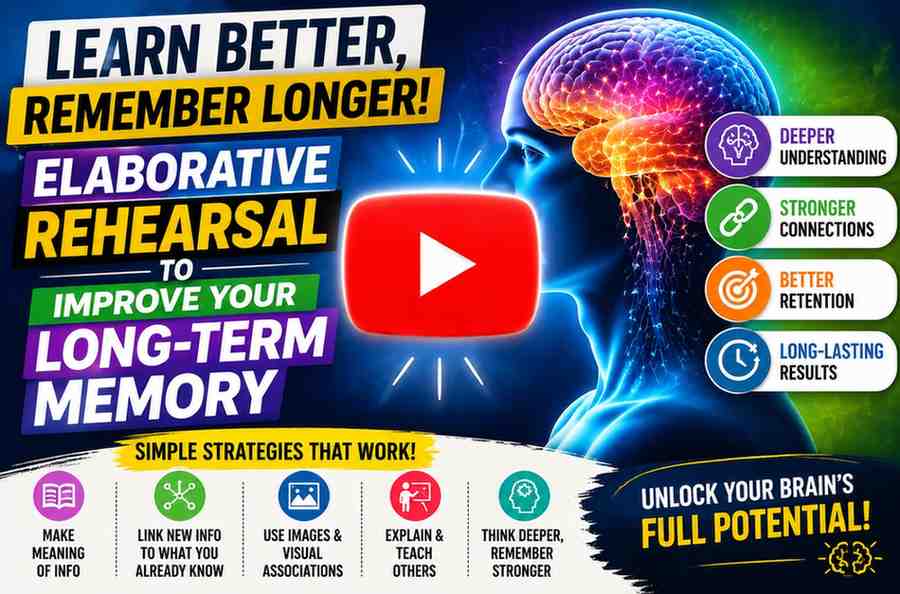
Benefits of Elaborative Rehearsal
Elaborative rehearsal offers several powerful benefits:
- Improves long-term memory retention
- Enhances understanding of complex topics
- Increases recall speed and accuracy
- Strengthens cognitive connections between ideas
- Makes learning more meaningful and engaging
- Reduces dependency on rote memorization
- Improves academic and professional performance
Because it aligns with how the brain naturally organizes information, it is one of the most efficient learning strategies available.
Common Mistakes to Avoid
While using elaborative rehearsal, avoid these errors:
1. Passive Reading
Simply reading without engaging the mind does not create strong memory traces.
2. Over-Reliance on Repetition
Repetition without meaning is ineffective for long-term memory.
3. Lack of Connections
If you do not link information to existing knowledge, retention decreases.
4. Multitasking While Learning
Divided attention weakens encoding and reduces memory performance.
Effective learning requires active mental engagement, not passive exposure.
Who Can Benefit from Elaborative Rehearsal?
This technique is useful for:
- Students preparing for exams
- Professionals learning new skills
- Language learners
- Medical and technical trainees
- Older adults aiming to maintain cognitive sharpness
- Anyone wanting to improve memory performance
Because it enhances the brain’s information processing, it is applicable across all ages and learning environments.
Final Thoughts
Elaborative rehearsal is more than just a study technique—it is a powerful cognitive strategy that transforms how you learn and remember information.
By focusing on meaning, connections, and understanding rather than simple repetition, you significantly increase your ability to store information in long-term memory.
The human brain remembers best when it understands. When you actively engage with information, relate it to existing knowledge, and create meaningful associations, you are not just memorizing—you are building a stronger, more organized memory system.
If you consistently apply elaborative rehearsal in your learning routine, you will notice improved recall, deeper understanding, and greater confidence in your knowledge.
References
About Us