
Hume Band vs Red Light Therapy: Which Is Better in 2026?
Health technology has evolved far beyond basic step counters and traditional wellness routines. Today, people can continuously monitor sleep, heart rate, recovery, and physiological stress with wearable devices while also using technologies such as red light therapy to support targeted wellness goals.
This raises an interesting question: Hume Band vs red light therapy—which option is more useful for improving your health?
The most important thing to understand is that these two technologies serve very different purposes. The Hume Band is primarily a health-monitoring wearable that collects physiological data throughout the day and night.
Hume Band tracks sleep, HRV, activity, and recovery, while red light therapy targets skin, pain, and tissue recovery through light-based treatment.
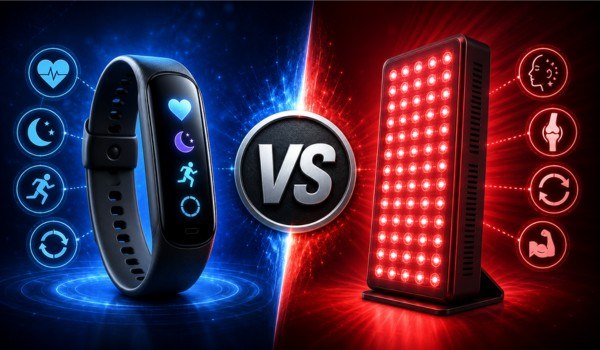
Red light therapy, also known as photobiomodulation, is an active light-based intervention that exposes tissue to specific wavelengths of red or near-infrared light.
In simple terms, Hume Band helps you measure and understand what your body is doing, while red light therapy attempts to stimulate biological responses within targeted tissues.
So choosing between them shouldn’t come down to which technology sounds more advanced. Your health goals, lifestyle, budget, willingness to track data, and reason for using the technology all matter.
This detailed Hume Band vs Red Light Therapy comparison examines how they work, their benefits, limitations, recovery potential, sleep applications, fitness usefulness, long-term value, and which one may be more appropriate for different users.
Hume Band vs Red Light Therapy: Quick Comparison
| Feature | Hume Band | Red Light Therapy |
|---|---|---|
| Main Purpose | Health tracking and personalized wellness insights | Targeted photobiomodulation therapy |
| Technology | Wearable sensors and health-data analysis | Red and near-infrared light |
| Heart Rate Tracking | Yes | No |
| HRV Tracking | Yes | No |
| Sleep Tracking | Yes | No |
| Recovery Monitoring | Yes | Does not directly monitor recovery |
| Activity Tracking | Yes | No |
| Skin Wellness | Indirect tracking only | Potential direct application |
| Muscle Recovery | Helps monitor recovery trends | May support recovery in some applications |
| Pain Management | Does not treat pain | Studied for certain pain conditions |
| Hair Growth | No direct treatment | Evidence exists for some forms of hair loss |
| Continuous Use | Designed for daily and nighttime wear | Used in scheduled sessions |
| Personalized Data | Strong advantage | Usually limited |
| Best For | Tracking sleep, stress, activity, and recovery | Targeted light-based wellness goals |
| Medical Device | No | Depends on the individual device and intended use |
What Is the Hume Band?
The Hume Band is a wearable health-monitoring device developed to provide continuous information about several physiological signals that can influence sleep, recovery, fitness, stress management, and general wellness.
Rather than focusing exclusively on steps or calories, the current Hume Band platform emphasizes understanding how different signals interact.
According to Hume Health, the wearable tracks measurements including continuous heart rate, heart rate variability, blood oxygen saturation, sleep stages, sleep quality, activity, movement, strain, recovery, skin temperature, and other health trends.
The device is designed to be worn throughout the day and during sleep so that users can see patterns rather than relying on occasional health measurements.
Hume also organizes information around concepts such as Metabolic Capacity, Strain, Recovery, and Metabolic Momentum. These measurements are intended to turn raw wearable data into information that is easier to apply to everyday decisions about exercise, rest, and lifestyle habits.
Importantly, Hume states that its Band is not a medical device and should not be used to diagnose, prevent or treat medical conditions. It should therefore be viewed as a wellness and self-monitoring tool, not a substitute for professional medical evaluation.

How Does the Hume Band Work?
Hume Band uses optical and motion sensors to continuously collect information from the wearer. Instead of viewing each measurement independently, the Hume ecosystem tries to identify patterns across multiple signals.
For example, an isolated heart-rate measurement may tell you very little. But combining resting heart rate with HRV, sleep quality, activity levels and recent strain can provide much more context regarding how recovered or stressed your body may be.
Heart rate variability is especially useful in modern recovery wearables. HRV measures variation in the timing between heartbeats. Changes in HRV can be influenced by training load, sleep, illness, psychological stress, and numerous other factors.
Hume Band combines these types of measurements with sleep and activity information to estimate recovery and daily capacity.
The device can also analyze sleep stages including light, deep and REM sleep, helping users identify whether lifestyle behaviors are associated with changes in sleep quality.
This makes Hume Band especially useful for people interested in health trends rather than isolated measurements.
✅ Click to Buy Hume Band at a Discounted Price!
What Is Red Light Therapy?
Red light therapy is a type of photobiomodulation, sometimes called low-level light therapy. It involves exposing the body to specific wavelengths of red or near-infrared light.
Scientific literature generally describes red-light photobiomodulation within approximately 620–700 nanometers, while near-infrared wavelengths extend beyond the visible red spectrum.
Unlike ultraviolet light, red light therapy is not intended to tan or burn the skin. Instead, researchers are studying how particular wavelengths may interact with cellular processes.
Red light therapy can be delivered through several types of equipment, including panels, masks, handheld devices, lamps and clinical systems.
Its potential applications vary considerably depending on the wavelength, intensity, treatment duration, distance from the light source and condition being treated.
Research has investigated photobiomodulation for areas such as skin appearance, hair growth, wound healing, pain, inflammation and certain musculoskeletal conditions, although the strength of evidence differs substantially between applications.
How Does Red Light Therapy Work?
Red light therapy does something fundamentally different from the Hume Band. Instead of collecting information about your body, it delivers light energy to tissue.
Researchers believe that photons from certain red and near-infrared wavelengths may interact with cellular photoreceptors, including components associated with mitochondria.
Mitochondria are responsible for producing much of the usable energy required by cells. Photobiomodulation research suggests that light exposure may influence processes involving mitochondrial activity, adenosine triphosphate, reactive oxygen species, calcium signaling, and other cellular pathways.
Researchers are investigating these biological responses for their potential effects on tissue repair, inflammation, circulation, cellular signaling, and recovery.
However, red light therapy should not be viewed as a universal treatment.
An extensive 2025 umbrella review evaluated 15 meta-analyses involving 204 randomized clinical trials and more than 9,000 participants.
Researchers found potentially beneficial effects for several outcomes but concluded that overall certainty ranged from very low to moderate, and no evaluated outcome had high-certainty evidence.
That distinction is important when comparing marketing promises with established scientific evidence.
Hume Band vs Red Light Therapy for Recovery
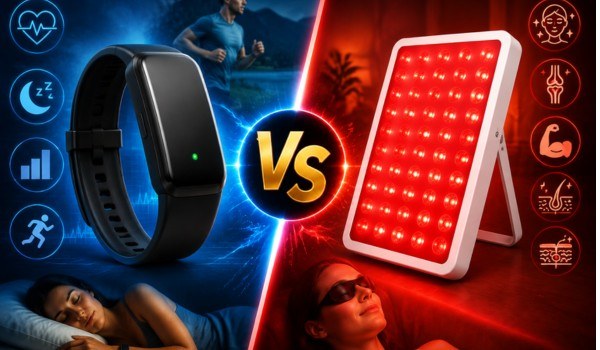
Recovery is one of the biggest areas where consumers may compare these technologies. However, the way each approaches recovery is completely different.
🔹 Hume Band for Recovery
Hume Band attempts to measure recovery. By analyzing HRV, resting heart rate, sleep, strain, activity, and related signals, the system can indicate whether your body appears ready for more demanding activity or may benefit from additional rest.
This approach is particularly useful for people who exercise frequently.
Imagine completing a difficult workout and sleeping poorly afterward. Even if you feel motivated to train again, your physiological trends may suggest you haven’t fully recovered.
A wearable cannot make the final decision for you, but it can provide another layer of information.
🔹 Red Light Therapy for Recovery
Red light therapy takes an intervention-based approach. Rather than measuring your recovery, photobiomodulation attempts to influence biological processes potentially related to tissue function, inflammation, or recovery.
Studies involving photobiomodulation and musculoskeletal health have reported promising findings in selected circumstances. However, treatment protocols vary considerably, so results from one device or clinical protocol cannot automatically apply to every home red-light panel.
🔹 Recovery Winner
For monitoring recovery: Hume Band wins. For influencing targeted tissue recovery: red light therapy has greater potential. For serious athletes, the two technologies could potentially complement each other rather than compete.
✅ Click to Buy Hume Band at a Discounted Price!
Hume Band vs Red Light Therapy for Sleep
Hume Band is clearly the more relevant technology when the goal is understanding sleep.
The wearable tracks sleep duration, sleep stages, and physiological signals recorded overnight. Users can then examine how habits such as bedtime consistency, exercise load, alcohol consumption, late meals, or stress correlate with their sleep patterns.
Red light therapy does not track sleep.
Some research is exploring light exposure and circadian biology, but conventional red light therapy should not be confused with clinically established sleep tracking or standard circadian-light interventions.
Therefore, someone mainly concerned with answering questions such as:
🔹 How much deep sleep am I getting?
🔹 Is my resting heart rate increasing overnight?
🔹 Does my HRV improve when I sleep earlier?
🔹 Am I accumulating recovery debt?
Would gain substantially more useful information from the Hume Band.
Winner for sleep tracking: Hume Band.
Hume Band vs Red Light Therapy for Skin Health
This category strongly favors red light therapy because the Hume Band does not directly treat the skin.
Photobiomodulation has been investigated for several dermatological applications. Red light may influence fibroblast activity, collagen-related processes, tissue circulation, and cellular signaling.
Cleveland Clinic notes that red light therapy is being studied for concerns including wrinkles, scars, redness, and other skin-related applications, while emphasizing that more high-quality research is still needed for many promoted uses.
Hume Band might indirectly support healthier habits by helping someone monitor sleep, recovery, and activity, but it cannot deliver a comparable targeted effect to skin tissue.
🔹 Winner for targeted skin wellness: Red Light Therapy.
Hume Band vs Red Light Therapy for Fitness
The better option depends on what part of fitness you are trying to improve. Hume Band is useful before, during, and after exercise because it provides a continuous view of physiological activity.
🔹 It can help users monitor:
- Daily activity
- Heart-rate patterns
- Training strain
- HRV
- Recovery
- Resting heart rate
- Sleep
- Movement
- Changes in physiological stress
This information can be particularly valuable when planning training intensity. Red light therapy cannot count workouts, monitor your heart rate, or identify your sleep patterns. However, red light therapy may appeal to athletes interested in potential applications related to muscle or tissue recovery.
Consequently, Hume Band is the more complete fitness-management tool, whereas red light therapy is better viewed as an optional recovery intervention.
Hume Band vs Red Light Therapy for Stress
Stress is another area where the difference between tracking and treatment becomes obvious.
Hume Band uses physiological measurements to identify patterns associated with strain and recovery. For example, changes in HRV combined with elevated heart rate and limited physical movement may provide clues that physiological stress is increasing.
That information can help users recognize situations that repeatedly affect their bodies. Red light therapy does not provide this kind of stress measurement.
Although researchers are studying photobiomodulation for a broad range of biological and neurological applications, consumers should be cautious about devices that promise dramatic improvements in stress, anxiety, or mental health without strong clinical evidence.
For everyday stress awareness and physiological tracking, Hume Band is much more practical.
🔹 Winner: Hume Band.
Hume Band vs Red Light Therapy for Pain
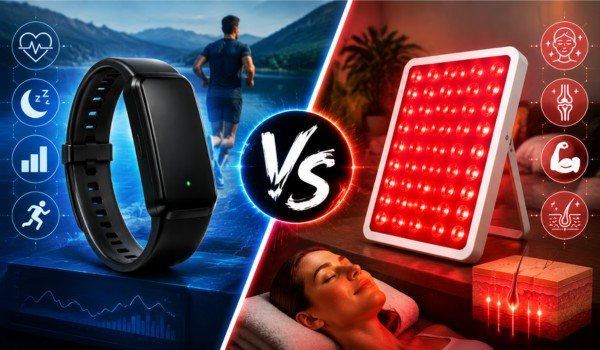
When pain management is the primary goal, the comparison changes. Hume Band does not treat pain.
It may help someone identify whether poor sleep, heavy activity, or inadequate recovery coincides with discomfort, but the wearable itself provides no therapeutic energy to painful tissue. Photobiomodulation, meanwhile, has been studied for several pain-related conditions.
Recent systematic evidence has shown promising results for selected conditions such as knee osteoarthritis, burning mouth syndrome, fibromyalgia, and certain other musculoskeletal problems, although the certainty of evidence differs significantly by condition and protocol.
Anyone with persistent or unexplained pain should still obtain an appropriate medical diagnosis rather than relying solely on a consumer wellness device.
🔹 Winner for targeted pain-related applications: Red Light Therapy.
Hume Band vs Red Light Therapy for Hair Growth
Red light therapy also has the advantage in this category. Low-level light therapy has been investigated as a potential intervention for androgenetic alopecia, or pattern hair loss.
The 2025 photobiomodulation umbrella review identified moderate-certainty evidence supporting improvements in hair density for androgenetic alopecia.
That does not mean every red-light helmet, cap, or panel will produce identical results. Device specifications, consistency, and the underlying cause of hair loss matter.
Hume Band has no direct hair-growth function.
🔹 Winner: Red Light Therapy.
Can Hume Band Track the Effects of Red Light Therapy?
This is where combining the two technologies becomes more interesting. A user could theoretically wear the Hume Band while incorporating red light therapy into a broader wellness routine and then observe changes in metrics such as:
- Resting heart rate
- HRV
- Sleep quality
- Activity
- Recovery
- Daily strain
- Skin temperature trends
However, one important limitation remains.
🔹 A change in wearable data does not prove that red light therapy caused it.
Suppose your HRV increases after three weeks of red light therapy. During the same period, you may also have improved your sleep, reduced alcohol intake, exercised differently, or experienced less work-related stress.
Wearables are excellent at identifying patterns, but they cannot automatically establish cause and effect.
For personal experimentation, the Hume Band could still help users record longer-term trends while keeping other lifestyle factors as consistent as reasonably possible.
✅ Click to Buy Hume Band at a Discounted Price!
Which Is Easier to Use?
Both technologies are relatively convenient, but the Hume Band requires less dedicated time.
Once charged and paired with the app, the Band is designed for continuous wear. The current Hume Band 2.0 is advertised with up to 14 days of battery life under typical use, reducing the need for charge it often.
Red light therapy requires deliberate sessions. Depending on the device, someone may need to sit or stand in front of a panel or position a smaller device over the targeted body area. Consistency matters, so users need to build sessions into their schedules.
🔹 Convenience winner: Hume Band.
Which Provides More Personalized Information?
Hume Band clearly wins here. Wearable technology becomes increasingly useful as it establishes your individual baseline. Your resting heart rate, HRV, and sleep patterns may look very different from another person’s.
The goal is therefore not always to compare yourself with a population average. Instead, monitoring your own trends can help you recognize whether something is moving away from your established baseline.
Red light therapy typically works through preset treatment protocols. Although users can adjust factors such as distance, treatment time, or intensity on certain devices, it usually does not continuously adapt based on your physiological measurements. For personalized health feedback, Hume Band offers substantially more data.
Hume Band Advantages
The major benefit of Hume Band is that it brings multiple pieces of health information together. Instead of relying solely on how tired or energetic you feel, you can examine objective trends alongside your subjective experience.
Its strongest advantages include continuous physiological monitoring, sleep tracking, HRV measurement, recovery insights, activity tracking, and long-term trend analysis.
It is especially appealing to people who enjoy using data to improve daily habits. Another advantage is that the device does not require a medical or clinical appointment for everyday wellness tracking. However, users should remember that wearable measurements are estimates and wellness metrics—not medical diagnoses.
Hume Band Limitations
Hume Band’s greatest limitation is also straightforward: tracking something does not automatically improve it. A wearable can tell you that your sleep is poor, but you still need to address the behaviors contributing to the problem. Likewise, seeing declining recovery metrics does not itself improve recovery.
You also should not rely on the Hume Band to diagnose heart conditions, sleep disorders, or other diseases. Hume explicitly identifies the Band as a non-medical device.
Some users may also focus too much on daily scores. Wearable information is generally most useful as a trend rather than as a definitive judgment about your health.
Red Light Therapy Advantages
Red light therapy’s major advantage is its potential to directly interact with targeted tissues. Unlike a wearable, it doesn’t simply observe the body.
Research into photobiomodulation has produced promising evidence for certain dermatological, hair-growth, wound-care, and pain-related applications.
A 2025 expert consensus also concluded that photobiomodulation has a favorable safety profile in adults and identified evidence supporting its use for selected clinical applications, although appropriate treatment protocols remain important. Red light therapy is also non-invasive and generally does not require medication.
Red Light Therapy Limitations
The biggest problem with red light therapy is the enormous variation between products and claims. The term red light therapy can describe devices with very different wavelengths, power densities, treatment distances, and exposure durations.
A clinical study demonstrating an effect with one protocol does not prove that every inexpensive home device will produce the same result.
Evidence is also stronger for some applications than others. Consumers should therefore be skeptical of products claiming red light therapy can effortlessly cause major weight loss, cure chronic diseases, or replace established medical treatments.
Cleveland Clinic similarly notes that evidence remains incomplete for many widely promoted uses.
✅ Click to Buy Hume Band at a Discounted Price!
Safety: Which Option Has Fewer Concerns?
Both technologies are generally non-invasive, but their safety considerations differ. Hume Band is similar to other wearable electronics.
Users should follow the manufacturer’s instructions for charging, skin contact, and device handling. Hume also warns users with implanted medical devices about the magnets contained in the product.
Red light therapy requires more attention to treatment protocol. Users should follow manufacturer guidance regarding exposure time, distance, and eye protection.
Professional guidance is sensible for people treating a medical condition or using medications or products that may increase sensitivity to light.
More treatment is not automatically better. Photobiomodulation depends on appropriate dosing, making responsible device use important.
Who Should Choose the Hume Band?
🔹 The Hume Band is likely the better option for people who want to:
- Understand their sleep quality
- Track HRV
- Monitor resting heart rate
- Measure everyday activity
- Follow recovery trends
- Understand how lifestyle habits affect physiological signals
- Monitor training strain
- Improve consistency with healthy behaviors
- Build a long-term picture of their wellness
- Use personalized data to guide everyday decisions
It is particularly suitable for fitness enthusiasts, health-conscious adults, athletes, and people who enjoy quantified-self technology.
Who Should Consider Red Light Therapy?
🔹 Red light therapy may be more relevant for someone primarily interested in:
- Targeted skin wellness
- Photobiomodulation
- Certain muscle-recovery applications
- Selected pain-management applications
- Supporting hair density in androgenetic alopecia
- A non-invasive wellness intervention
Anyone considering it for a diagnosed medical condition should discuss the approach with an appropriate healthcare professional.
Can You Use Hume Band and Red Light Therapy Together?
Yes. In many cases, comparing Hume Band and red light therapy as though you must choose one is unnecessary. They may work better as complementary technologies because they perform different roles.
You could think of the combination like this: Hume Band = measurement; red light therapy = intervention. For example, someone pursuing better athletic recovery might use red light sessions as one component of their recovery routine while wearing Hume Band to monitor sleep, HRV, resting heart rate, and overall recovery trends.
Likewise, someone using red light therapy for skin concerns could still use the Hume Band independently to improve sleep and lifestyle consistency. The important point is not to assume improvements in wearable metrics automatically prove red light therapy caused them.
Hume Band vs Red Light Therapy: Which Offers Better Long-Term Value?
Long-term value depends entirely on why you are purchasing the technology. Hume Band provides value every day because continuous data can help reveal lifestyle patterns.
Someone who actively uses that information may learn how sleep timing, exercise, stress, rest days, and other behaviors affect their physiology.
But if you rarely check the data or never act on the recommendations, the value decreases considerably. Red light therapy’s value depends much more heavily on the specific reason it is being used.
Someone buying a quality device for an evidence-supported application may find it worthwhile. Someone purchasing a red-light device based on exaggerated promises may be disappointed.
Therefore, Hume Band generally offers broader everyday usefulness, whereas red light therapy can offer greater value for selected targeted purposes.
Hume Band vs Red Light Therapy: Which Is Better?
There is no universal winner because the two technologies solve different problems. For sleep tracking, HRV, daily activity, cardiovascular trends, stress awareness, and recovery monitoring, the Hume Band is the stronger choice.
For targeted photobiomodulation involving certain skin, hair, tissue, or pain-related applications, red light therapy is more relevant.
🔹 If your primary question is:
🔹 “What is happening inside my body from day to day?”
Choose Hume Band.
If your primary question is:
🔹 “Can targeted light exposure support this specific wellness goal?”
Red light therapy may be more appropriate.
For someone deeply interested in optimizing health, combining wearable monitoring with carefully selected evidence-based wellness interventions may provide the most useful approach.
Final Verdict
In the Hume Band vs Red Light Therapy comparison, the Hume Band is the better overall tool for people who want continuous, personalized information about sleep, heart rate, HRV, activity, strain, and recovery.
Red light therapy is different. It is an active wellness intervention rather than a monitoring device, and its strongest potential lies in targeted applications with meaningful scientific support for photobiomodulation.
If I had to choose only one for a typical health-conscious adult, I would choose the Hume Band for broader everyday usefulness because it can continuously reveal how sleep, exercise, stress, and recovery patterns change over time.
However, someone specifically interested in skin rejuvenation, certain hair-loss applications, or targeted photobiomodulation may gain more direct value from a well-designed red light therapy system.
Ultimately, these technologies should not be viewed as direct competitors. Hume Band helps you understand your body, while red light therapy attempts to influence specific biological processes. Knowing that difference makes it much easier to choose the tool that actually fits your health goals.
✅ Click to Buy Hume Band at a Discounted Price!
Frequently Asked Questions
Is Hume Band the same as red light therapy?
No. Hume Band is a wearable health tracker that collects physiological information, while red light therapy exposes tissue to specific wavelengths of red or near-infrared light. One primarily measures health-related signals, while the other is an intervention.
Does the Hume Band provide red light therapy?
No. The lights and optical sensors used by wearable health trackers are designed primarily to collect physiological measurements. They should not be confused with therapeutic photobiomodulation devices.
Can Hume Band track recovery?
Yes. Hume Band combines information such as HRV, resting heart rate, sleep, and strain to provide recovery-related insights. Interpret these measurements as wellness information, not medical diagnoses.
Is red light therapy scientifically proven?
Red light therapy has scientific evidence supporting selected applications, but the evidence is not equally strong for every advertised benefit. Recent systematic research describes the overall certainty of evidence across many health outcomes as ranging from very low to moderate.
Is red light therapy good for muscle recovery?
Researchers have studied photobiomodulation for exercise and musculoskeletal recovery, but results depend on treatment parameters and individual circumstances. It should complement, not replace, appropriate training, nutrition, sleep, and medical care when necessary.
Can red light therapy improve sleep?
Research continues to investigate light and circadian biology, but red light therapy is not a sleep-monitoring system. If you’re mainly interested in measuring sleep stages, sleep efficiency, and nighttime physiological trends, the Hume Band will provide far more relevant information.
Can I use the Hume Band while doing red light therapy?
Generally, you can incorporate them into the same wellness routine because they serve different functions. Follow the instructions for both devices, and remember that changes recorded by the wearable cannot prove red light therapy caused them.
Which is better for athletes: Hume Band or red light therapy?
For most athletes, Hume Band provides broader everyday usefulness because it monitors sleep, recovery, HRV, activity and strain. Red light therapy may serve as an additional targeted recovery tool rather than replacing a wearable.
Which is better for skin: Hume Band or red light therapy?
Red light therapy is more appropriate for targeted skin applications. The Hume Band may encourage healthier sleep and lifestyle habits but does not directly treat skin.
Is the Hume Band a medical device?
No. Hume Health states that the Hume Band is not a medical device and should not replace professional medical advice, diagnosis, or treatment.
Is Hume Band vs Red Light Therapy really a fair comparison?
Not entirely. They belong to different health-technology categories. Hume Band is primarily a monitoring platform, whereas red light therapy is an intervention. Comparing them is useful mainly for determining which technology better matches a specific wellness goal.

Click To Learn More About Hume Band
Reference
https://en.wikipedia.org/wiki/Low-level_laser_therapy
https://www.webmd.com/skin-problems-and-treatments/red-light-therapy
https://www.healthline.com/health/red-light-therapy
About Us
