Titanium vs Bamboo Cutting Board: Which Is Better in 2026?
Choosing the right cutting board can make a noticeable difference in food preparation, knife performance, kitchen hygiene, maintenance, and overall cooking convenience.
Two options that have attracted increasing attention are titanium cutting boards and bamboo cutting boards. While both provide durable surfaces for preparing food, they perform very differently because they are made from completely different materials.
A titanium cutting board offers a hard, nonporous, moisture-resistant surface that is designed for easy cleaning and long-term durability.
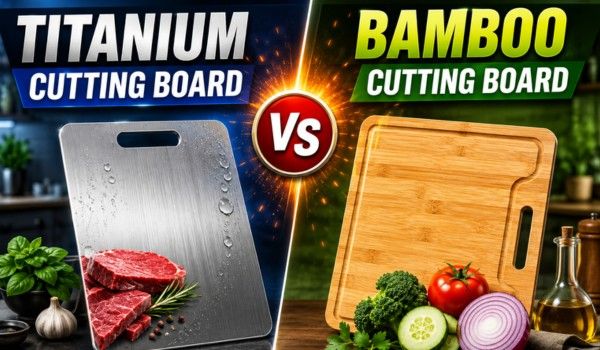
Bamboo, on the other hand, provides a more traditional cutting experience with a naturally warm appearance and a surface that generally feels softer under a knife than metal.
So, when comparing a titanium cutting board vs bamboo cutting board, which option actually makes more sense?
There is no single answer for every kitchen. Titanium can appeal to people who prioritize sanitation, low maintenance, stain resistance, and durability.
Bamboo may be more suitable for cooks who prioritize knife comfort, affordability, appearance, and a familiar chopping experience.
This detailed comparison looks at how titanium and bamboo cutting boards differ in construction, hygiene, durability, knife friendliness, maintenance, weight, sustainability, cost, food preparation, and everyday practicality.
What Is a Titanium Cutting Board?
A titanium cutting board is a food-preparation surface made entirely of titanium or, in some products, made with titanium-containing metal construction.
Consumers should always check the manufacturer’s specifications because products marketed using the word “titanium” may differ in their actual composition.
Titanium itself is a strong metal known for its corrosion resistance, durability, and relatively low weight compared with many other metals. These characteristics explain why titanium has become popular in cookware, outdoor equipment, medical applications, and premium kitchen accessories.
When used as a cutting-board surface, titanium provides a smooth, nonporous surface that does not absorb liquids in the way bamboo or wood can.
This makes titanium convenient for preparing foods that release moisture, such as vegetables, fruits, meat, poultry, and seafood.
Another attraction is its simple maintenance. Because titanium does not require oiling or conditioning like many natural-material cutting boards, it may appeal to people who want a cutting board that requires minimal routine care.
However, its extremely hard surface also creates one of the biggest considerations: knife-edge wear. Cutting repeatedly on a metal surface can put more stress on knife edges than cutting on softer materials.
So titanium isn’t automatically the best option just because it is durable.
What Is a Bamboo Cutting Board?
A bamboo cutting board is made from strips or pieces of bamboo that are processed, bonded, compressed, and shaped into a solid cutting surface.
Although bamboo is commonly discussed alongside hardwood cutting boards, bamboo is technically a type of grass. It grows rapidly and can be harvested more quickly than many hardwood trees, which has contributed to its popularity as a kitchen material.
Bamboo cutting boards are typically firm, lightweight, visually attractive, and relatively affordable. Their natural appearance works well in traditional and modern kitchens alike.
Compared with titanium, bamboo is more flexible and softer, though it can still be quite hard compared with certain woods.
Many cooks appreciate the feel of chopping vegetables, herbs, fruit, bread, and other ingredients on bamboo because the surface does not feel as rigid or metallic.
However, bamboo requires more maintenance than titanium. Excessive moisture, soaking, dishwasher cleaning, or improper drying may eventually contribute to warping, splitting, cracking, or separation between bonded sections. Regular care is therefore important for extending its lifespan.

Titanium Cutting Board vs Bamboo Cutting Board: Quick Comparison
| Feature | Titanium Cutting Board | Bamboo Cutting Board |
|---|---|---|
| Surface | Very hard and nonporous | Firm natural surface |
| Knife Friendliness | Lower | Better |
| Water Resistance | Excellent | Moderate |
| Stain Resistance | Excellent | Good |
| Odor Resistance | Excellent | Good with proper care |
| Maintenance | Very low | Moderate |
| Durability | Very high | Good |
| Dishwasher Suitability | Depends on manufacturer | Usually not recommended |
| Weight | Moderate | Usually lightweight |
| Appearance | Modern and metallic | Natural and warm |
| Sustainability | Long-lasting but energy-intensive material | Renewable plant material |
| Cost | Usually higher | Usually affordable |
| Cracking Risk | Very low | Possible |
| Warping Risk | Very low | Possible |
| Best For | Hygiene and low maintenance | Everyday chopping and knife comfort |
1. Cutting Surface and Overall Feel
The most obvious difference between titanium and bamboo is how the surface feels while cutting.
Titanium provides a very firm, rigid cutting surface. When a knife contacts the board, the material offers virtually no cushioning.
Some users appreciate this solid feeling, while others may find the metallic contact uncomfortable during longer chopping sessions. The sound can also be noticeably sharper than the sound created by a knife contacting bamboo or wood.
Bamboo creates a more familiar kitchen experience. Although bamboo can be harder than some traditional wooden cutting boards, it still provides more give than titanium.
For chopping onions, herbs, peppers, carrots, fruit, and similar ingredients, bamboo may therefore feel more comfortable. If cutting feel is one of your biggest priorities, bamboo generally has an advantage.
2. Knife Friendliness
Knife protection is one of the most important factors when selecting a cutting board.
A cutting board should ideally be softer than the knife edge. When the blade repeatedly strikes an extremely hard surface, the fine cutting edge can gradually become dull, roll, or require sharpening more frequently.
Titanium is substantially harder and less forgiving than bamboo. Therefore, chefs and home cooks who use expensive, carefully sharpened knives may prefer avoiding titanium as their primary chopping surface.
Bamboo is gentler, though it shouldn’t automatically be considered the softest cutting-board material available. Bamboo contains natural mineral components and is generally harder than several traditional hardwood surfaces.
Even so, when directly comparing bamboo vs titanium for knife preservation, bamboo is usually the more knife-friendly option. For people who sharpen knives frequently and prioritize sanitation above everything else, titanium’s hardness may be acceptable.
For people who want their knife edges to stay sharp longer, bamboo is usually the better choice of these two materials.
3. Hygiene and Food Safety
Kitchen hygiene is a major reason titanium cutting boards have attracted attention. Titanium has a nonporous surface, meaning liquids and food residues are less likely to penetrate deeply into the material.
After preparing meat, vegetables, fish, or fruit, you can generally wash the board thoroughly with appropriate dishwashing detergent and water, following the manufacturer’s care instructions. Bamboo behaves differently because it is a natural plant-based material.
A properly maintained bamboo cutting board can still be used hygienically, but the board must be cleaned and dried correctly. Cuts, grooves, cracks, or damaged sections may make cleaning more difficult over time. Regardless of which material you choose, basic kitchen hygiene remains essential.
Wash cutting boards after preparing food, avoid letting raw-meat liquids remain on the surface, dry the board properly, and consider using separate boards for raw proteins and foods eaten without further cooking. Titanium has the advantage when low-absorption hygiene and straightforward cleaning are top priorities.
4. Water Resistance
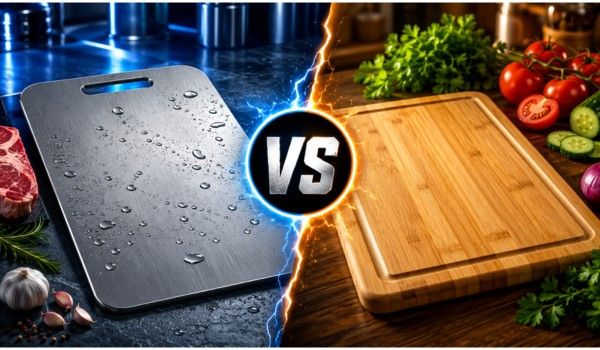
Titanium performs exceptionally well around moisture. Water does not soak into titanium, and the metal resists corrosion under normal kitchen conditions.
This makes titanium attractive for people who regularly prepare juicy fruits, tomatoes, seafood, meat, or other moisture-rich ingredients.
Bamboo is more sensitive to prolonged water exposure. Generally, it should not be left submerged in a sink. Excessive moisture may eventually contribute to swelling or changes in the board’s structure.
Repeated soaking followed by rapid drying can increase the possibility of cracking or warping. Therefore, wash bamboo boards promptly and let them dry thoroughly. For water resistance, titanium clearly has the advantage.
5. Durability
Titanium is known for its durability. A quality titanium cutting surface is unlikely to crack, swell, absorb water, or develop the same structural issues that natural-material boards may experience.
The surface may develop scratches from repeated cutting, but these marks are mostly cosmetic and common with normal use. With proper maintenance, a bamboo cutting board can also last for years. However, its lifespan depends much more heavily on quality and care.
🔹Lower-quality bamboo boards may eventually show:
- Deep knife grooves
- Edge separation
- Cracking
- Warping
- Surface roughness
- Discoloration
Premium bamboo construction and proper maintenance can significantly reduce these problems.
If long-term physical durability with minimal maintenance is the priority, titanium generally performs better.
6. Cleaning and Maintenance
One of titanium’s biggest advantages is convenience. Titanium does not typically need routine oiling or conditioning. After use, you can clean, rinse, dry, and store the board.
Always follow the manufacturer’s instructions regarding dishwasher use because construction and finishes can vary between products. Bamboo requires more careful maintenance.
Avoid leaving bamboo submerged in water for prolonged periods. After washing, dry it rather than allowing water to sit on the surface.
Depending on the board and manufacturer’s instructions, food-safe mineral oil or another appropriate board-conditioning product may occasionally be recommended to help maintain the surface.
For a household wanting the lowest-maintenance cutting board, titanium is generally the easier option.
7. Stain Resistance
Cutting colorful foods can quickly reveal differences between materials. Beets, berries, turmeric, tomatoes, sauces, herbs, and strongly pigmented ingredients may leave temporary or persistent discoloration on some natural cutting boards.
Titanium resists food staining because pigments cannot easily penetrate the nonporous metal. Bamboo has reasonably good stain resistance when maintained properly, but its surface can still discolor over time.
Deep knife marks may also trap food residue or pigments more readily than an intact surface. If you want a consistently clean-looking surface, titanium generally resists staining better.
8. Odor Resistance
Garlic, onions, seafood, meat, spices, and strongly flavored foods may leave lingering odors on cutting surfaces. Titanium’s nonporous structure makes it less likely to retain strong food odors after proper washing.
Bamboo can occasionally retain smells, especially when the surface has accumulated knife marks or hasn’t been cleaned and dried properly.
This does not necessarily make bamboo unsanitary, but it may require more attention after preparing particularly aromatic ingredients. For frequent preparation of fish, garlic, onions, and raw meats, titanium may provide a practical advantage.
9. Weight and Portability
Bamboo cutting boards are generally lighter than many dense cutting-board materials. This makes them convenient when you frequently move a board between the counter, sink, dining table, and storage area.
Titanium is also relatively lightweight for a metal, but the actual weight depends heavily on the thickness and dimensions of the board.
A large or thick titanium board may still feel heavier than a similar bamboo model. If portability matters, compare the actual product dimensions and weight rather than relying only on the material.
10. Stability While Cutting
A cutting board should remain stable during food preparation.
Some lightweight titanium boards may slide across smooth countertops unless they have non-slip feet, a textured backing, or another stability feature.
Bamboo boards may offer slightly more natural friction, but they can also slide depending on the countertop surface. A simple solution for either material is to place a clean, damp kitchen towel or non-slip mat under the board while chopping.
Stability should always take priority because a moving cutting board can increase the possibility of knife accidents.
11. Appearance
Appearance may not affect cooking performance, but cutting boards often remain visible on kitchen counters. Titanium provides a minimalist, sleek, contemporary look. It pairs particularly well with stainless-steel appliances and modern kitchen designs.
Bamboo has a much warmer appearance. Its natural grain can complement traditional kitchens, farmhouse designs, Scandinavian interiors, wooden cabinets, and neutral décor.
People who want a cutting board that doubles as an attractive serving surface may prefer bamboo. For modern aesthetics, titanium wins. For natural aesthetics, bamboo wins.
12. Food Preparation Versatility
Both materials work for many kitchen tasks, but their strengths differ.
🔹 A titanium cutting board can work particularly well for:
- Preparing raw meat
- Cutting fish
- Slicing fruit
- Handling juicy foods
- Preparing strong-smelling ingredients
- Quick food-preparation tasks
- Situations requiring easy cleanup
🔹 Bamboo works particularly well for:
- Chopping vegetables
- Cutting fruit
- Slicing bread
- Preparing sandwiches
- Chopping herbs
- Everyday meal preparation
- Serving cheese or snacks
Home cooks who do a lot of chopping may find bamboo more comfortable because it is easier on the knife edge. Titanium may be better as a specialized preparation surface rather than the only board in the kitchen.
Titanium Cutting Board Pros
🔹 Excellent Moisture Resistance
Titanium does not absorb normal kitchen moisture, making it convenient when preparing wet or juicy ingredients.
🔹 Easy to Clean
Its smooth, nonporous surface can generally be cleaned quickly after food preparation.
🔹 Highly Durable
Titanium resists cracking, swelling, and warping better than plant-based cutting boards.
🔹 Resistant to Odors
Strong-smelling ingredients are less likely to leave lingering odors after thorough washing.
🔹 Resistant to Stains
Food pigments cannot easily penetrate the metal surface.
🔹 Low Maintenance
No regular conditioning or oiling is normally required.
🔹 Modern Appearance
Titanium provides a sleek aesthetic suitable for contemporary kitchens.
🔹 Long Service Life
High-quality titanium products can potentially remain usable for many years when properly cared for.
Titanium Cutting Board Cons
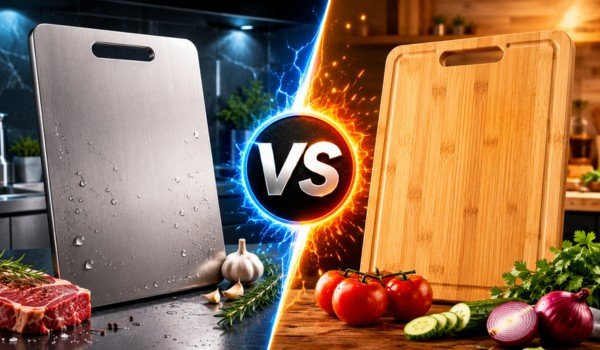
Despite its advantages, titanium is not ideal for everyone.
Its biggest disadvantage is the very hard cutting surface. Regular knife contact with metal can dull knife edges more quickly than softer surfaces.
Titanium boards can also produce more noise when chopping. Some models may slide on smooth countertops unless they include non-slip features. Titanium cutting boards generally cost more than standard bamboo boards.
Another consideration is product quality. Some products marketed as “titanium” may use titanium coatings, titanium alloys, or other metals rather than solid titanium. Consumers should review product specifications rather than buying based solely on marketing terms.
Bamboo Cutting Board Pros
🔹 More Knife Friendly
Bamboo provides more cushioning than titanium and is therefore generally easier on knife edges.
🔹 Comfortable Cutting Experience
The surface feels familiar for chopping vegetables and everyday ingredients.
🔹 Affordable
Bamboo cutting boards are widely available across many price ranges.
🔹 Attractive Natural Appearance
Their warm grain makes them suitable for both preparation and presentation.
🔹 Lightweight
Most bamboo boards are easy to move, wash, and store.
🔹 Renewable Material
Bamboo grows relatively quickly, making it attractive to environmentally conscious consumers.
🔹 Widely Available
Consumers can choose from numerous sizes, thicknesses, shapes, and designs.
🔹 Versatile
Bamboo works well for chopping, slicing, serving, and general food preparation.
Bamboo Cutting Board Cons
Bamboo requires more maintenance than titanium. Don’t soak it for long periods, as moisture may eventually contribute to warping or cracking.
The board may also develop deep knife grooves over time. Some bamboo products use adhesives to bond individual bamboo strips, so manufacturing quality matters.
Bamboo is also relatively hard compared with several traditional hardwood cutting-board materials, so it is not necessarily the gentlest possible option for premium knife edges. Still, it provides noticeably more forgiveness than a metal board.
Which Cutting Board Is More Hygienic?
From a maintenance perspective, titanium has an advantage because it is nonporous and moisture-resistant. This characteristic can make cleaning easier after preparing raw foods.
However, material alone does not determine kitchen safety. Even the most nonporous cutting board still needs proper cleaning after use.
Likewise, you can use bamboo safely if you clean it promptly, keep it dry, maintain it properly, and replace it when it’s heavily damaged.
Separate cutting boards can also add convenience. For example, reserve one board for raw meat and seafood, while using another for vegetables, fruit, bread, and ready-to-eat foods.
Which Cutting Board Is Better for Knives?
Between these two choices, bamboo is generally better for protecting knife edges. Titanium is extremely hard. Each time a knife strikes the metal surface, the blade edge experiences greater resistance.
Frequent use may therefore increase sharpening requirements. Bamboo is softer than metal and produces less direct impact on the cutting edge.
People using premium chef’s knives, Japanese knives, or very thin cutting edges should consider knife compatibility carefully before choosing titanium as their primary chopping board.
Which Cutting Board Lasts Longer?
Titanium typically wins for structural longevity. It does not experience common natural-material problems such as water absorption, splitting, swelling, or warping.
Bamboo can still provide excellent service life, especially if you purchase a quality board and maintain it correctly. However, repeated moisture exposure and years of knife contact will gradually change its surface.
Titanium is therefore more attractive if your goal is purchasing one extremely durable preparation surface.
Which Is Easier to Maintain?
Titanium is easier. Cleaning and drying are usually the primary maintenance requirements. Bamboo requires additional attention to moisture exposure and storage.
Store a bamboo board where air can circulate around it, rather than leaving it continuously wet against a countertop. For busy households that want simple cleanup, titanium can be attractive. For cooks who do not mind basic cutting-board maintenance, bamboo remains practical.
Titanium Cutting Board vs Bamboo for Meat
Titanium can be especially convenient when preparing raw meat because liquids stay on the surface rather than soaking deep into the material. After preparation, you can thoroughly wash the board according to its care instructions.
Bamboo can also be used for meat, but you must clean it promptly. If For regularly prepare chicken, beef, pork, or seafood, a separate dedicated protein cutting board may be preferable regardless of material.
Titanium Cutting Board vs Bamboo for Vegetables
Bamboo generally provides the more enjoyable surface for extensive vegetable chopping. The repeated rocking movement used with a chef’s knife feels more natural on bamboo than on metal.
Titanium is perfectly capable of handling vegetables, but the hard surface may become noticeable when chopping large quantities of carrots, onions, potatoes, peppers, and herbs.
For occasional slicing, titanium performs well. For extended chopping sessions, bamboo is usually more comfortable.
Titanium Cutting Board vs Bamboo for Everyday Use
For everyday use, the better choice depends on your priorities.
🔹 Choose titanium if you value:
- Easy cleaning
- Moisture resistance
- Stain resistance
- Odor resistance
- Minimal maintenance
- Long-term durability
🔹 Choose bamboo if you value:
- Better knife protection
- Comfortable chopping
- Natural appearance
- Lower cost
- Lightweight handling
- Familiar cutting-board performance
Many cooks may actually benefit from owning both. You could use a titanium board for messy, wet, or strongly scented foods, while bamboo works well for most everyday chopping.
Environmental Considerations
Bamboo is frequently promoted as an environmentally friendly material because bamboo plants grow rapidly and can regenerate relatively quickly.
However, the environmental impact of a bamboo cutting board also depends on manufacturing, adhesives, transportation, processing, and how long the product remains usable.
Titanium requires considerably more industrial processing to produce. At the same time, titanium’s durability means a quality board may remain functional for a very long period.
Therefore, sustainability should not be judged using only one characteristic. A durable product that is used for many years may generate less replacement waste than inexpensive products that are frequently discarded.
Price Comparison
Bamboo is generally the more affordable choice. Basic bamboo cutting boards are available at relatively low prices, while premium thick boards remain reasonably accessible.
Titanium boards are typically positioned as premium kitchen products and may cost considerably more. Before paying extra, confirm the actual material composition.
Look for clear information about thickness, dimensions, surface construction, manufacturing specifications, and care instructions. A higher price does not automatically guarantee better performance for every type of cutting task.
Who Should Choose a Titanium Cutting Board?
A titanium cutting board may be suitable for someone who prioritizes durability, water resistance, easy cleaning, and minimal maintenance. It can also be useful for cooks who regularly prepare wet foods, fish, meat, fruit, garlic, onions, or strongly colored ingredients.
People who dislike replacing warped or heavily stained boards may particularly appreciate titanium. However, users with expensive knives should consider that the hard surface may affect blade sharpness.
Who Should Choose a Bamboo Cutting Board?
A bamboo board may be better for people who spend a lot of time chopping vegetables, herbs, fruit, bread, and other everyday ingredients.
It is also a strong choice for households seeking an affordable cutting board with a natural appearance. Home cooks who want better knife friendliness than a metal surface will likely prefer bamboo.
Bamboo is particularly suitable when you are comfortable washing the board by hand, drying it promptly, and performing occasional maintenance.
✅ Get Titanium at the Lowest Price Today!
Can You Use Both?
Yes, and this may actually be the most practical solution.
Instead of treating the titanium cutting board vs bamboo cutting board debate as an all-or-nothing decision, consider assigning different tasks to each surface.
For example, use titanium for raw meat, seafood, juicy fruit, garlic, onions, and ingredients likely to stain. Bamboo could then handle vegetables, herbs, bread, sandwiches, fruit, cheese, and longer chopping sessions. Using multiple boards also makes it easier to separate raw foods from ready-to-eat ingredients.
Important Things to Check Before Buying
Before buying either type, focus on product quality rather than choosing based solely on material. For titanium boards, check whether the product is actually constructed from titanium or simply marketed with titanium-related terminology.
🔹 Look at:
- Material composition
- Thickness
- Surface finish
- Dimensions
- Weight
- Non-slip design
- Cleaning instructions
- Manufacturer information
🔹 For bamboo boards, consider:
- Board thickness
- Construction quality
- Surface smoothness
- Edge finishing
- Adhesive quality
- Care instructions
- Size
- Juice grooves
- Non-slip features
A well-made bamboo board can outperform a poorly manufactured titanium product, and the opposite is equally true.
Frequently Asked Questions
Is a titanium cutting board better than bamboo?
Titanium is better for water resistance, stain resistance, durability, and easy maintenance. Bamboo is generally better for knife friendliness, chopping comfort, affordability, and natural appearance.
Do titanium cutting boards dull knives?
Because titanium provides a very hard surface, frequent chopping on titanium can potentially dull knife edges faster than cutting on softer materials such as bamboo or many wooden boards.
Is bamboo good for cutting boards?
Yes. Bamboo is widely used for cutting boards because it is durable, lightweight, attractive, and relatively affordable. Proper cleaning and drying are important for maintaining the board.
Can bamboo cutting boards absorb water?
Bamboo can absorb moisture, particularly through damaged areas, edges, joints, or prolonged water exposure. Bamboo boards should therefore not normally be soaked for extended periods.
Does titanium absorb food odors?
Titanium is nonporous, so it resists absorbing odors. Proper washing should remove most food residue and smells.
Are titanium cutting boards good for raw meat?
Their nonporous, moisture-resistant surface can make titanium boards convenient for raw-meat preparation, as long as you clean the board thoroughly afterward.
Which board is better for expensive knives?
Bamboo is generally the better option between the two because it is less rigid than titanium and provides a more forgiving surface.
Which board requires less maintenance?
Titanium normally requires less maintenance because it does not require the moisture management or periodic conditioning associated with many natural cutting-board materials.
Final Verdict: Titanium Cutting Board vs Bamboo Cutting Board
The Titanium Cutting Board vs Bamboo Cutting Board comparison ultimately comes down to what you expect from your kitchen tools.
A titanium cutting board stands out for durability, hygiene-focused design, moisture resistance, stain resistance, odor resistance, and low maintenance.
It is particularly convenient for messy food preparation and users who prefer a surface that does not require oiling or careful moisture management.
Its biggest weakness is also difficult to ignore: titanium is an extremely hard surface. Frequent knife contact may dull blades faster, making it less attractive for cooks who prioritize knife-edge preservation.
A bamboo cutting board offers a more comfortable and traditional chopping experience. It is generally easier on knives than titanium, affordable, lightweight, attractive, and versatile enough for most everyday cooking tasks.
The trade-off is maintenance. Bamboo needs careful cleaning and drying and can eventually show knife grooves, stains, cracks, or warping.
For most home cooks performing regular chopping, bamboo is likely the more practical primary cutting board because of its balance of comfort, price, durability, and knife friendliness.
For people who prioritize easy sanitation, liquid resistance, durability, and minimal maintenance, titanium can be an excellent secondary or specialized preparation surface.
In many kitchens, the best solution isn’t choosing only one. Using bamboo for everyday chopping and titanium for wet, messy, strongly scented, or raw ingredients gives the best of many advantages of both materials while reducing their individual disadvantages.

Click To Learn More About Titanium
References
https://en.wikipedia.org/wiki/Cutting_board
https://www.webmd.com/food-recipes/food-safety-tips
https://www.healthline.com/nutrition/what-is-cross-contamination
About Us