At What Age Is Your Brain Fully Developed? Science Explained
At What Age Is Your Brain Fully Developed? Understanding the Science Behind Brain Maturity
The human brain is one of the most complex organs in the body, responsible for everything we think, feel, and do. From decision-making and emotional control to memory and personality, it shapes who we are.
One of the most frequently asked questions in neuroscience and psychology is: “At what age is your brain fully developed?”
For years, many people have believed that the brain becomes fully mature at age 25. But is this truly a biological fact—or just a simplified rule of thumb? The answer is more nuanced than a single number.
The brain is not fully developed at a single age. The prefrontal cortex matures around 25, but brain growth and adaptation continue into adulthood.
In this article, we’ll explore how the brain develops from childhood through adulthood, what actually matures around age 25, and why brain development is a lifelong process influenced by experience, environment, and biology.

Understanding Brain Development: A Lifelong Process
Brain development begins before birth and continues throughout life. At birth, a baby’s brain is already equipped with billions of neurons, but the connections between them are still forming rapidly.
During childhood and adolescence, the brain undergoes major changes, such as:
- Rapid formation of neural connections (synaptogenesis)
- Strengthening of important pathways
- Elimination of unused connections (synaptic pruning)
- Growth of white matter to improve communication between brain regions
These changes allow the brain to become more efficient and specialized over time.
However, brain development does not end when childhood ends. It continues well into early adulthood—and even beyond.
So, At What Age Is the Brain Fully Developed?
Scientific research shows that the brain does not develop all at once. Instead, different parts mature at different rates.
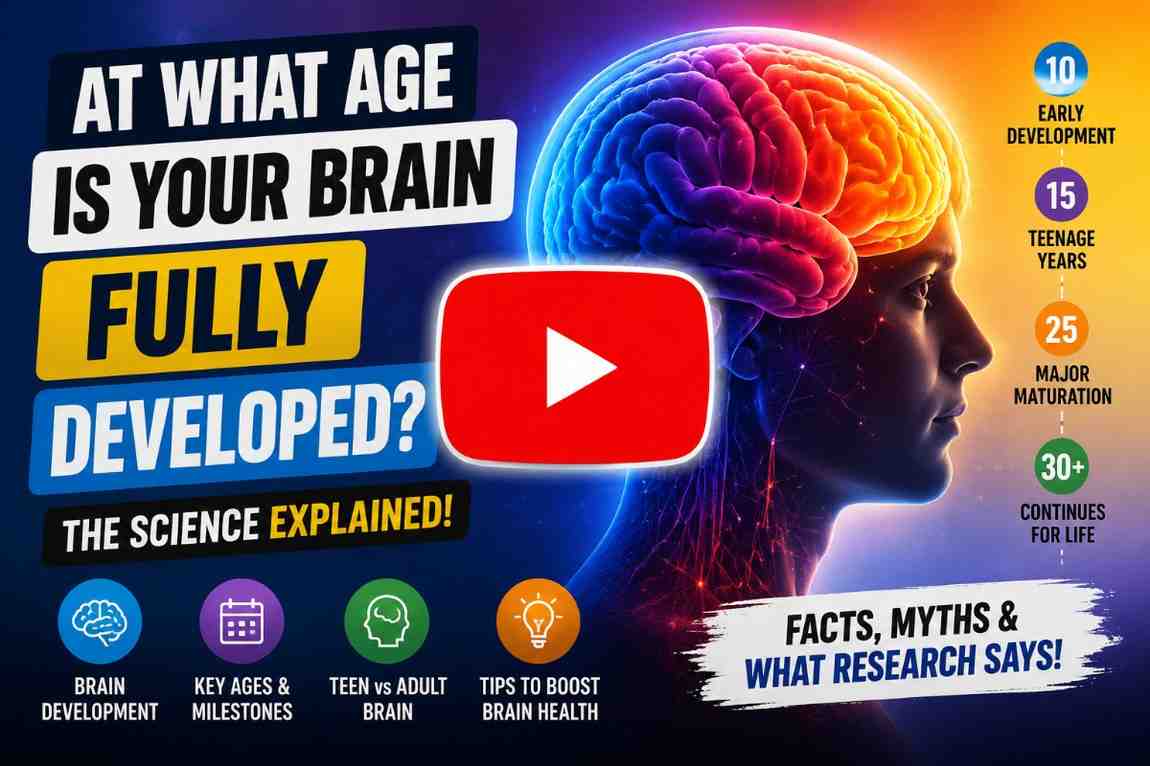
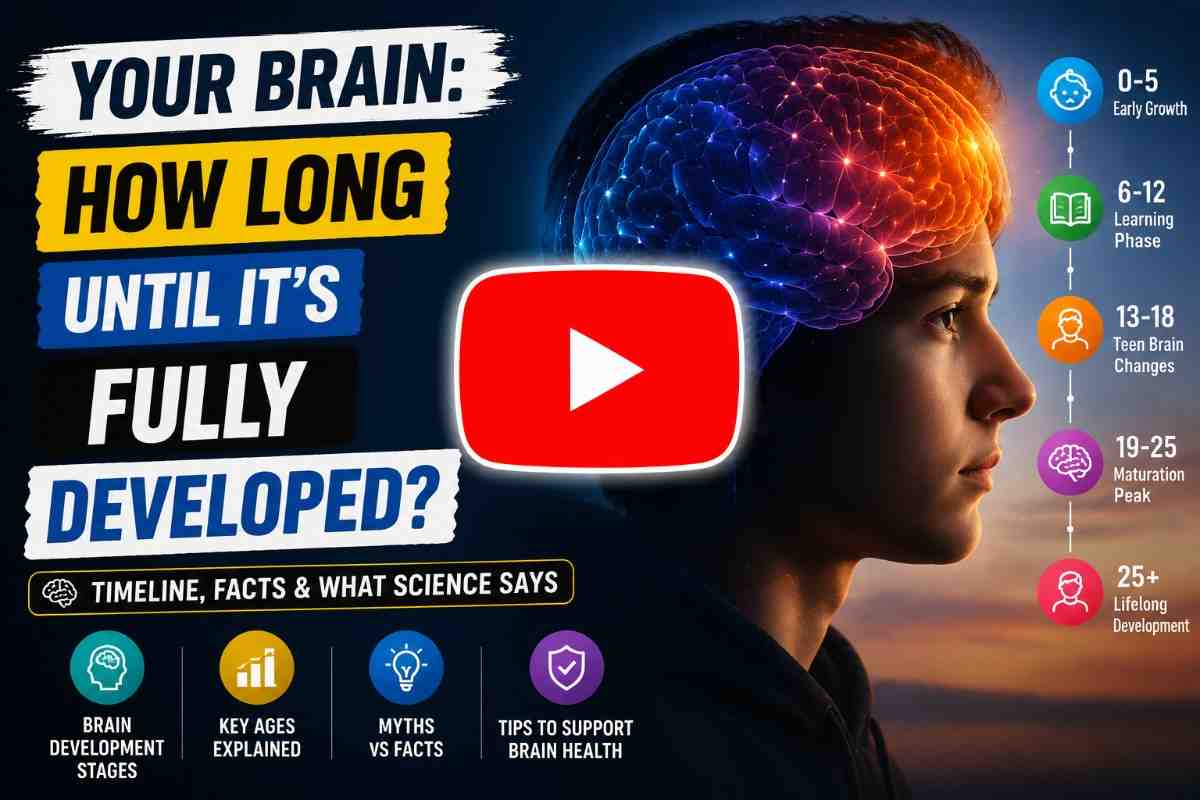
Most neuroscientists agree on the following general timeline:
- Basic brain size development: Mostly complete by age 5–6
- Adolescent brain remodeling: Continues through the teenage years
- Prefrontal cortex maturation: Continues into the mid-20s
- Full functional stability: Often extends into the late 20s or early 30s
One of the most important findings in neuroscience is that the prefrontal cortex, the part of the brain responsible for decision-making and impulse control, is among the last regions to mature. This region is often considered “fully developed” around the mid-20s.
However, newer research suggests that brain organization and connectivity may continue refining into the 30s.
The Role of the Prefrontal Cortex: The Last Piece of the Puzzle
The prefrontal cortex (PFC) is located in the front of the brain, just behind the forehead. It is responsible for:
- Decision-making
- Planning and organizing
- Impulse control
- Emotional regulation
- Understanding consequences
- Long-term thinking
Because these abilities require complex neural coordination, the prefrontal cortex takes longer to develop than other brain regions.
During adolescence, this part of the brain is still under construction. This is why teenagers and young adults may:
- Take more risks
- Struggle with long-term planning
- React emotionally in stressful situations
- Make impulsive decisions
As the prefrontal cortex matures, these abilities gradually improve, leading to better judgment and self-control.
This maturation is why many studies suggest that brain development continues into the mid-20s, particularly around ages 23–25.
Why Age 25 Became the “Magic Number”
The idea that the brain fully develops at age 25 comes from early neuroscience research that observed patterns in brain maturation.
MRI studies showed that:
- Gray matter decreases (due to pruning and refinement) through adolescence
- White matter increases (improving communication between brain regions) into the mid-20s
- The prefrontal cortex shows late structural development
These findings led scientists to use age 25 as an approximate benchmark for when key structural brain development stabilizes.
However, it is important to understand that:
There is no sudden switch at age 25 when the brain becomes “fully adult.”
Instead, age 25 represents an average milestone, not a strict biological cutoff.
The Truth: Brain Development Has No Exact Finish Line
Modern neuroscience now shows that brain development is far more complex than previously believed.
While the prefrontal cortex is one of the last areas to mature, research indicates that:
- Brain structure continues changing into the 30s
- Neural pathways keep adapting based on experience
- Learning and memory reshape the brain throughout life
- Emotional regulation improves with maturity and life experience
This means the brain is never truly “finished.” Instead, it remains adaptable through a process called neuroplasticity.
What Happens in the Brain During Your 20s?
Your 20s are a critical transition phase in brain development.
During this period, the brain undergoes:
1. Refinement of Neural Connections
Unused connections are eliminated while important ones are strengthened.
2. Increased Efficiency
Communication between different brain regions becomes faster and more organized.
3. Emotional Regulation Improvements
The connection between the emotional centers and the prefrontal cortex strengthens.
4. Better Decision-Making
Long-term thinking begins to outweigh short-term impulses.
This is why many people notice significant emotional and cognitive maturity during their mid-to-late 20s.
Does the Brain Keep Developing After 25?
Yes—and in many ways, it continues to evolve throughout life.
After the mid-20s:
- The brain becomes more stable structurally
- Cognitive skills become more refined
- Experience plays a major role in shaping behavior
- Emotional intelligence continues to improve
Even though major structural development slows, the brain remains highly adaptable.
For example:
- Learning a new language strengthens new neural pathways
- Meditation can increase emotional regulation areas
- Physical exercise improves memory and cognitive function
- Social experiences reshape emotional responses
This lifelong adaptability is what allows humans to continue learning and growing at any age.
Factors That Influence Brain Development
Brain development is not only determined by age. Several important factors influence how the brain matures:
1. Genetics
Genetic makeup plays a role in how quickly and efficiently the brain develops.
2. Environment
A stimulating environment with learning opportunities enhances brain growth.
3. Nutrition
Proper nutrition supports healthy brain function, especially during early development.
4. Sleep
Sleep is critical for memory consolidation and neural repair.
5. Stress Levels
Chronic stress can negatively impact brain development and emotional regulation.
6. Lifestyle Choices
Exercise, learning, and mental stimulation help strengthen brain connections.

Why Teenagers and Young Adults Behave Differently
Behavioral differences between teenagers and adults are strongly linked to brain development.
In teenagers:
- The emotional brain (amygdala) is highly active
- The rational brain (prefrontal cortex) is still developing
- Risk-taking behavior is more common
In adults:
- Emotional responses are more balanced
- Decision-making is more rational
- Impulse control is stronger
This imbalance gradually stabilizes as brain connections mature.
Is the Brain Ever “Fully” Developed?
The answer depends on how we define “fully developed.”
- Structurally: Major development completes in the mid-to-late 20s
- Functionally: Improvements continue into the 30s
- Cognitively: Lifelong learning continues indefinitely
- Emotionally: Growth continues through experience
So rather than a fixed endpoint, brain development is best understood as a continuous process of refinement and adaptation.
Key Takeaway
The brain does not suddenly become fully developed at age 25. Instead, age 25 is a general milestone marking the completion of major structural development—especially in the prefrontal cortex.
However, brain function, emotional maturity, and cognitive skills continue to evolve throughout adulthood.
In simple terms:
Your brain is never truly “finished”—it keeps growing, adapting, and improving throughout your life.
Final Thoughts
Understanding brain development helps us make better sense of human behavior, especially during adolescence and early adulthood. It also highlights the importance of healthy habits, learning, and emotional growth at every stage of life.
Rather than focusing on a single “fully developed age,” it is more accurate to view the brain as a lifelong learning system—constantly shaped by experiences, environment, and personal choices.
📚References
About Us