
Are There Any Side Effects of the Blue Salt Trick? The Truth
Yes, the Blue Salt Trick can have side effects, particularly when it involves consuming extra salt or using concentrated salt mixtures.
The biggest concern isn’t the blue color itself, but of much sodium you consume.
The “Blue Salt Trick” has recently spread across social media as a supposed wellness hack, with some versions claiming to improve hydration, energy, circulation, stamina, testosterone, or even erectile function.
However, these claims should not be confused with established medical evidence.
There is currently no good clinical evidence that the viral Blue Salt Trick treats erectile dysfunction, increases testosterone, burns fat, or produces a special boost in blood flow.
Some online versions also vary considerably, making it difficult to know exactly what people are consuming.

The important question, therefore, is not simply whether blue salt is “good” or “bad.” It is how much sodium the method adds to your diet, what other ingredients are included, and whether you have conditions that make excess sodium more concerning.
What Is the Blue Salt Trick?
The Blue Salt Trick is a loosely defined internet wellness trend, not a standardized medical treatment.
Different videos and websites describe different versions. Some involve dissolving blue or Persian blue salt in water, while other versions add ingredients such as lemon, honey, ginger, or other products.
Some social-media posts promote the method specifically for men and associate it with:
- Better blood flow
- Stronger erections
- Increased stamina
- Higher energy
- Improved testosterone
- Weight loss
- Hydration
- Sexual performance
The problem is that no single standardized Blue Salt Trick formula exists. The ingredients, quantities, and instructions can change from one viral post to another.
That makes broad claims about its benefits especially difficult to evaluate.
Why Has the Blue Salt Trick Become So Popular?
The trend fits a larger social-media pattern: a simple household ingredient is presented as a hidden health “hack.”
The visually distinctive color of Persian blue salt also makes the trend particularly suitable for short-form videos.
Searches have expanded beyond “what is blue salt?” to terms such as “blue salt trick for men,” “blue salt trick for ED,” “blue salt under tongue,” “blue salt horse trick,” and “blue salt recipe.” Current online coverage shows that the trend is increasingly being tied to sexual-performance claims.
This creates an important SEO and health-information distinction:
Popularity on TikTok, YouTube, or search engines does not establish medical effectiveness.
A claim needs appropriate clinical evidence before it can be treated as a proven health benefit.
 DON’T TRY THIS “BLUE SALT TRICK” UNTIL YOU SEE THIS
What Are the Possible Side Effects of the Blue Salt Trick?
The potential side effects depend mainly on how much salt is consumed and how frequently the method is used.
1. Increased Sodium Intake
The most obvious concern is adding extra sodium to an already salty diet.
Sodium is an essential mineral involved in fluid balance, nerve function, and muscle function. The problem is that many people already consume more sodium than recommended.
Adding a daily salt-water drink on top of normal meals can increase total sodium exposure without providing a proven therapeutic benefit.
Recent research continues to support the relationship between higher salt intake and higher blood pressure.
A 2026 systematic review and meta-analysis of randomized trials found that higher salt intake was associated with higher blood pressure, while reducing salt was associated with greater blood-pressure reductions.
2. Higher Blood Pressure
This is one of the more important potential concerns.
Extra sodium can cause the body to retain more fluid, which can contribute to increases in blood pressure in salt-sensitive individuals.
A large body of evidence connects excessive sodium intake with hypertension and cardiovascular risk. Recent evidence continues to support sodium reduction as an important strategy for improving blood-pressure control.
This matters particularly if someone already has:
- High blood pressure
- Heart disease
- Kidney disease
- A sodium-restricted diet
- Certain conditions involving fluid retention
For these individuals, experimenting with a concentrated salt drink may be a particularly poor trade-off.
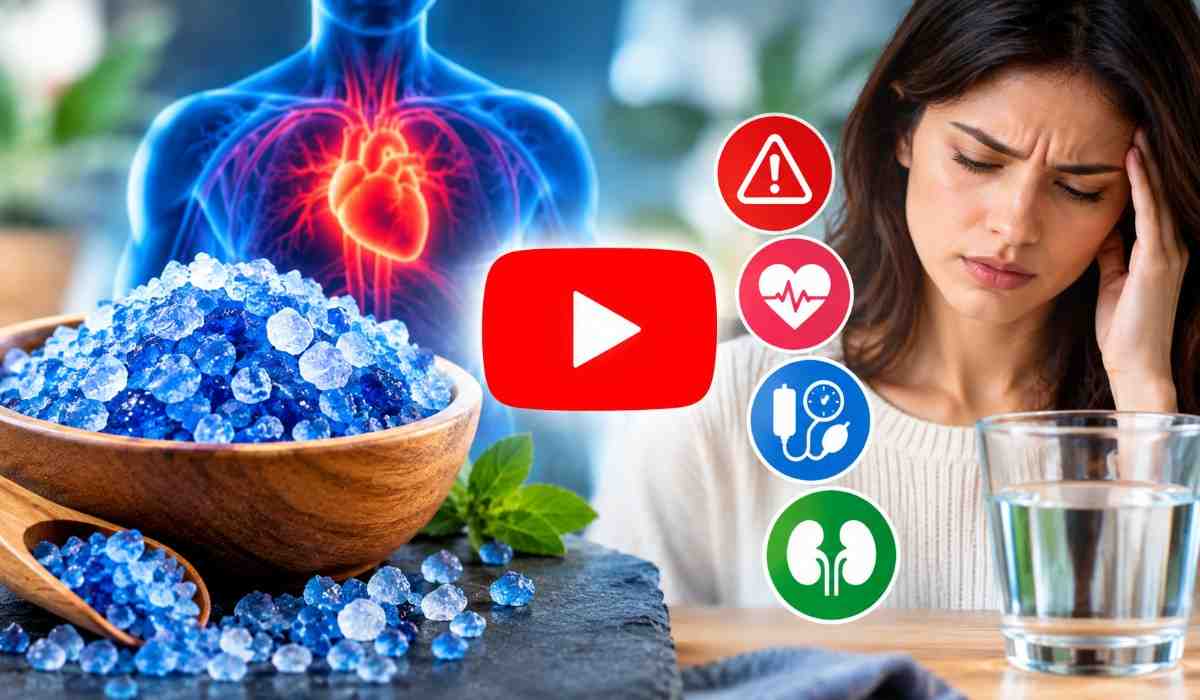
3. Thirst and Fluid Retention
A salty drink can make some people feel thirstier.
Because sodium affects fluid balance, consuming a large amount of salt does not automatically mean better hydration.
This is an important misconception behind viral electrolyte hacks.
More salt does not automatically mean more hydration.
Electrolytes have useful physiological roles, but adding unnecessary sodium to ordinary drinking water isn’t automatically better than drinking water based on your body’s needs.
4. Stomach Discomfort
Some people may experience digestive discomfort after consuming concentrated salty mixtures.
Depending on the recipe, the drink may also include lemon, ginger, baking soda, honey, or other ingredients that can irritate the stomach in sensitive individuals.
Because viral recipes aren’t standardized, itis hard to predict how each version will affect digestion.
5. Problems for People With Kidney Conditions
The kidneys play an important role in regulating sodium and fluid balance.
People with kidney disease may have specific dietary sodium restrictions based on their individual condition.
For that reason, don’t treat a viral salt-based health hack as harmless just because it contains a “natural” mineral.
If you have kidney disease or have been told to restrict sodium, follow your clinician’s dietary advice rather than experimenting with concentrated salt mixtures.
6. Possible Cardiovascular Concerns
Excessive sodium intake can contribute to elevated blood pressure, a major cardiovascular risk factor.
Research has also examined associations between high sodium intake and cardiovascular outcomes beyond blood pressure. Reviews continue to support reducing excessive sodium exposure as part of cardiovascular risk reduction.
This is why claims that adding salt can automatically improve circulation should be treated cautiously.
DON’T TRY THIS “BLUE SALT TRICK” UNTIL YOU SEE THIS
Does the Blue Salt Trick Cause Erectile Dysfunction?
There is no good evidence that the Blue Salt Trick directly causes erectile dysfunction.
However, the viral claim that salt improves erections is also not supported by convincing clinical evidence.
An erection depends heavily on healthy blood-vessel function and adequate blood flow.
Because excessive sodium intake can contribute to high blood pressure and vascular problems, deliberately increasing salt intake is not an evidence-based strategy for improving erectile function.
Current medical coverage of the trend similarly concludes that no evidence shows the Blue Salt Trick improves ED.
This creates an important distinction:
“Salt does not cure ED” does not mean “salt immediately causes ED.”
The more accurate message is that the viral method has not been demonstrated to improve erectile function, while excessive sodium intake can create health concerns that are relevant to cardiovascular and vascular health.
What About the Blue Salt Trick Under the Tongue?
Another version of the trend involves placing salt under the tongue.
Some promote this as a faster way to absorb minerals or to trigger an immediate effect.
No established medical evidence shows that putting blue salt under the tongue produces a special benefit for erections, testosterone, fat loss, or energy.
In addition, concentrated salt may be unpleasant or irritating to the mouth.
A faster route of absorption does not automatically make a substance more effective.
What About the Blue Salt Horse Trick?
The phrase “blue salt horse trick” has also appeared alongside the broader trend.
Don’t assume every recipe using this name is the same. Online versions vary, and some mix blue salt with other ingredients.
The name itself doesn’t prove the method has a specific physiological effect.
This is a useful lesson for evaluating viral health hacks: a memorable name can spread much faster than the evidence behind it.
Can Blue Salt Improve Blood Flow?
This is one of the biggest claims associated with the trend.
No strong clinical evidence shows that consuming blue salt produces a therapeutic improvement in blood flow.
The argument often sounds plausible because erections depend on blood flow. But that does not mean any substance that contains minerals will improve erectile circulation.
In fact, sodium is more commonly studied in relation to blood pressure and cardiovascular health than as an erectile-performance enhancer.
Recent research continues to find meaningful effects of sodium reduction on blood pressure, particularly among people with hypertension.
Therefore, the claim should be treated as unproven rather than established fact.
DON’T TRY THIS “BLUE SALT TRICK” UNTIL YOU SEE THIS
Does Blue Salt Help With Weight Loss?
Another emerging claim is that a blue salt drink can accelerate metabolism or burn belly fat.
No convincing evidence shows that adding blue salt to water directly causes meaningful fat loss.
If a person replaces a high-calorie soft drink with plain water containing a tiny amount of salt, any change in calorie intake could be related to the beverage substitution—not a special fat-burning property of blue salt.
Salt itself should not be marketed as a weight-loss ingredient.
Does Blue Salt Detox the Body?
The word “detox” is frequently used in viral wellness content because it sounds simple and powerful.
But adding salt to water does not give the body a special detox pathway.
Your liver, kidneys, lungs, and gastrointestinal system already perform important processes and eliminate substances from the body.
A salt-water drink should not be presented as a substitute for normal nutrition, medical treatment or evidence-based lifestyle habits.
Blue Salt vs. Regular Salt: Is Blue Salt Safer?
The blue appearance does not automatically make a salt safer.
Persian blue salt is a type of mineral salt, and its distinctive appearance comes from its mineral composition and crystal structure.
But “natural,” “rare,” or “mineral-rich” does not mean you can consume it without limit.
From a sodium perspective, the key issue remains total sodium intake.
The important question is not:
“Is blue salt healthier because it is blue?”
A better question is:
“How much sodium am I consuming, and do I actually need the additional salt?”
Viral Blue Salt Claims: Fact vs. Hype
| Viral claim | What the evidence says |
| Blue salt cures ED | Not established |
| Blue salt increases testosterone | No reliable clinical evidence |
| Blue salt burns belly fat | Not established |
| Blue salt dramatically improves blood flow | Not established |
| Blue salt detoxes the body | Unsupported |
| Blue salt can provide sodium and minerals | Yes, depending on the product |
| Too much sodium can raise blood pressure | Supported by substantial evidence |
| Everyone should avoid all salt | Too simplistic; sodium is an essential nutrient |
This distinction matters, especially when reading social-media health content.
A claim can be biologically plausible, popular, and repeated thousands of times while still lacking clinical evidence.
DON’T TRY THIS “BLUE SALT TRICK” UNTIL YOU SEE THIS
Common Mistakes People Make With the Blue Salt Trick
Mistake 1: Assuming Natural Means Safe
Natural mineral salts are still sources of sodium.
The word “natural” does not eliminate the effects of consuming too much sodium.
Mistake 2: Copying a Viral Recipe Exactly
Online recipes may not provide reliable measurements.
One creator may use a tiny amount while another uses a much larger quantity.
Mistake 3: Taking More Because It Did Not Work
This is especially risky with viral health hacks.
If there is no noticeable effect, increasing the dose does not prove that the original amount was simply too small.
Mistake 4: Using It Instead of Medical Treatment
Someone experiencing persistent erectile dysfunction, high blood pressure or other symptoms should not rely on a viral salt method instead of appropriate evaluation.
Mistake 5: Confusing Testimonials With Clinical Evidence
A person saying “it worked for me” is an anecdote.
Clinical evidence requires controlled research involving enough participants to determine whether an intervention actually produces a reliable effect.
Who Should Be Especially Careful With Salt Tricks?
Extra caution is appropriate for people who have been advised to limit sodium, particularly those with:
- High blood pressure
- Kidney disease
- Heart failure or certain cardiovascular conditions
- Fluid-retention problems
- A medically prescribed low-sodium diet
Pregnant individuals or people taking medications that affect fluid or electrolyte balance should also avoid assuming that viral salt recipes are automatically appropriate.
If you have a medical condition or have been prescribed a sodium restriction, discuss dietary changes with your healthcare professional.
Is There a Safe Way to Try the Blue Salt Trick?
The safest approach is not to treat the Blue Salt Trick as a medical treatment.
If you simply enjoy blue salt as a culinary ingredient, using an appropriate amount as part of normal food preparation is very different from deliberately consuming concentrated salt water for a supposed therapeutic effect.
A practical approach is:
- Check the ingredient label.
- Avoid products with undisclosed ingredients.
- Do not assume a larger amount will produce better results.
- Avoid replacing prescribed treatment with the trend.
- Watch your overall sodium intake.
- Be particularly cautious if you have hypertension, kidney, or cardiovascular problems.
The goal should be moderation rather than chasing a viral dose.
What Should You Do Instead of the Blue Salt Trick?
If your reason for searching for the Blue Salt Trick is better energy, circulation or sexual health, focus on interventions with stronger evidence.
For cardiovascular and vascular health, useful priorities include:
- Maintaining a healthy weight
- Regular physical activity
- Eating a balanced diet
- Limiting excessive sodium
- Avoiding tobacco
- Getting adequate sleep
- Managing chronic conditions
- Addressing persistent symptoms with a healthcare professional
For erectile dysfunction specifically, it is worth remembering that ED can sometimes be associated with underlying cardiovascular, metabolic, medication-related or psychological factors.
A viral salt recipe cannot reliably identify or address those causes.
DON’T TRY THIS “BLUE SALT TRICK” UNTIL YOU SEE THIS
The Bottom Line: Are There Any Side Effects of the Blue Salt Trick?
Yes. The main potential concern is unnecessary sodium exposure, especially when the trick involves drinking concentrated salt water or repeatedly adding extra salt to the diet.
Blue salt isn’t a magic ingredient just because it looks different from ordinary salt.
There is also no convincing clinical evidence that the viral Blue Salt Trick treats ED, increases testosterone, burns fat, or dramatically improves circulation.
The most important recent trend is actually the spread of multiple versions of the trick, including blue salt drinks, under-the-tongue methods, “horse trick” variations, and men’s-health claims. Because the recipes are inconsistent, users should be especially careful about copying instructions from social media.
If you enjoy blue salt as a food seasoning, that is a different issue from consuming it as a supposed treatment.
The safest takeaway is simple: don’t confuse a viral health hack with a clinically proven therapy. When it comes to salt, the amount matters more than the color.
References
- Wikipedia — Salt
https://en.wikipedia.org/wiki/Salt
- Healthline — What Happens If You Eat Too Much Salt?
https://www.healthline.com/nutrition/what-happens-if-you-eat-too-much-salt
- PubMed — Sodium Reduction and Blood Pressure
https://pubmed.ncbi.nlm.nih.gov/42716956/
About Us
