Neuropathy Exercises for Seniors: Safe Exercise Guide
Neuropathy exercises for seniors can help improve balance, muscle strength, mobility, and daily function, especially when numbness or weakness affects the feet and legs.
The safest approach usually combines gentle aerobic activity, strengthening, balance training, and stretching, adjusted to the person’s ability and cause of neuropathy.
Exercise does not guarantee that damaged nerves will heal, but research suggests it can improve physical function and, particularly in diabetic neuropathy, support better balance, gait, and overall health.
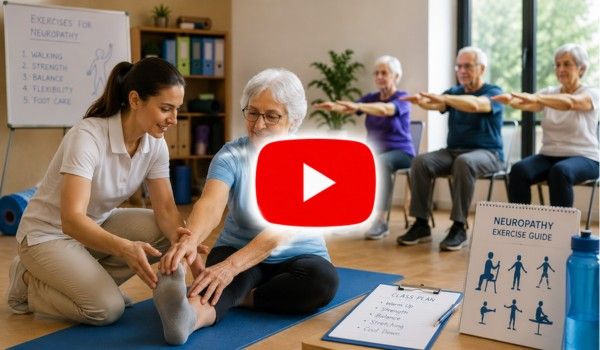

Quick Summary
Neuropathy exercise advice has become popular online because many seniors are searching for simple ways to manage numbness, burning feet, weakness, and fall concerns at home.
The key truth is that gentle, consistent movement can be useful, but viral claims that a particular exercise can “reverse neuropathy” quickly are not supported by strong evidence.
Why Are Neuropathy Exercises for Seniors Trending?
Searches for neuropathy exercises have grown alongside interest in managing chronic nerve symptoms without relying entirely on medication.
Social media videos frequently show older adults performing seated leg movements, toe exercises, balance drills, walking routines, or stretching sequences.
This has created understandable curiosity: Can exercise actually repair damaged nerves? Which exercises are safe for seniors? Can walking make neuropathy worse?
These questions are especially important because neuropathy can affect sensation, muscle control, and balance.
Peripheral neuropathy refers to disorders involving nerves outside the brain and spinal cord, and symptoms can include numbness, tingling, pain, weakness, and unsteadiness.
However, social media often simplifies the science. A short video may suggest that one movement “regrows nerves” or permanently eliminates neuropathy. Such claims should be treated cautiously.
Exercise is better understood as part of neuropathy management and physical rehabilitation, not a guaranteed cure.
 DON’T TRY THIS “NEUROPATHY EXERCISES FOR SENIORS” UNTIL YOU SEE THIS
What Are the Best Neuropathy Exercises for Seniors?
There is no single exercise routine that is appropriate for every senior with neuropathy. The best program depends on the cause of neuropathy, symptoms, strength, balance, cardiovascular health, foot condition, and fall risk.
A practical program may include these four categories:
- Gentle aerobic exercise
- Leg and core strengthening
- Balance exercises
- Stretching and range-of-motion movements
For diabetic peripheral neuropathy, evidence supports combining aerobic, resistance, and balance activities when appropriate.
NCBI guidance also emphasizes adjusting exercise type, intensity, frequency, and duration to the individual’s needs.
1. Gentle Walking for Neuropathy
Walking is one of the simplest aerobic exercises for seniors who can safely walk.
A slow walk can help maintain leg strength and general cardiovascular fitness. For someone who has been inactive, beginning with a short period and gradually increasing activity may be more realistic than immediately attempting a long walk.
A senior with significant numbness should pay particular attention to footwear and foot condition. Reduced sensation can make it harder to notice blisters, cuts, pressure points, or injuries.
WebMD also recommends regular physical activity as part of managing nerve pain and notes that walking can be a useful starting point for some people.
Beginner approach: Start with a comfortable duration and pace. If walking outdoors feels unsafe, consider walking indoors in a clear, well-lit area.
2. Seated Leg Extensions
Seated leg extensions can be useful for seniors who have difficulty standing for long periods.
Sit securely in a sturdy chair with the back supported. Slowly straighten one knee, pause briefly, and lower the foot back down. Repeat on the opposite side.
This movement targets the muscles around the thigh and may be easier than standing exercises.
The goal is controlled movement, not speed. If a senior has severe weakness, joint problems, or significant pain, a physical therapist should modify the exercise.
3. Sit-to-Stand Exercises
The sit-to-stand movement closely resembles an everyday activity: getting out of a chair.
It can strengthen the legs and hips while practicing functional movement.
Use a stable chair and keep it against a secure surface if necessary. Stand up slowly, then sit down with control rather than dropping into the chair.
Seniors with poor balance should initially perform this exercise with supervision or professional guidance.
Research in older adults shows that appropriately designed resistance and functional exercise can improve measures such as chair-rise performance, walking speed, and physical function

4. Calf Raises
Calf raises can help maintain lower-leg strength.
Stand behind a sturdy chair or near another stable support. Slowly raise the heels, then lower them back down.
For seniors with neuropathy, support is especially important because reduced sensation in the feet can make balance exercises harder.
Do not perform unsupported calf raises if there is a substantial risk of falling.
5. Ankle Pumps and Ankle Circles
Ankle movements are convenient because you can do them while sitting.
For ankle pumps, move the feet up and down slowly. For ankle circles, gently rotate one ankle in each direction.
These movements are primarily useful for maintaining comfortable range of motion and keeping the ankles moving. They should not be presented as a cure for nerve damage.
They may be particularly convenient for seniors who cannot tolerate prolonged standing or walking.
DON’T TRY THIS “NEUROPATHY EXERCISES FOR SENIORS” UNTIL YOU SEE THIS
6. Gentle Calf and Hamstring Stretching
Stretching can help maintain flexibility, particularly when neuropathy is accompanied by stiffness or reduced mobility.
You can do a simple seated hamstring stretch by extending one leg forward while keeping the movement comfortable and controlled.
For a calf stretch, use a wall or stable support and avoid forcing the ankle into an uncomfortable position.
Healthline lists calf and hamstring stretching among exercises commonly used for peripheral neuropathy, alongside aerobic and balance activities.
Stretching should create a gentle sensation, not sharp pain, burning, or worsening neurological symptoms.
7. Supported Balance Exercises
Balance training deserves special attention in seniors with neuropathy.
Nerve damage in the feet can reduce the sensory information used to maintain stability. This can make standing and walking more difficult.
A simple supported balance exercise involves standing behind a sturdy chair while lightly holding it. The senior can practice maintaining a stable stance before progressing to more challenging movements.
Possible exercises include:
- Supported heel-to-toe standing
- Weight shifting from one leg to another
- Controlled side steps
- Supported single-leg practice when appropriate
Never perform balance exercises near stairs, slippery surfaces, or unstable furniture.
Research specifically examining exercise in peripheral neuropathy has found promising evidence for balance training, while newer evidence in older adults generally supports exercise approaches that target balance and functional movement.

8. Chair-Based Exercises for Seniors With Severe Symptoms
Not every senior with neuropathy can safely begin with standing exercises.
Chair-based exercise can provide an alternative for people with reduced endurance, significant weakness, or mobility limitations.
Examples include:
- Seated marching
- Ankle pumps
- Seated knee extensions
- Gentle hip movements
- Upper-body movements
- Seated posture exercises
These movements can help maintain activity when standing exercise is temporarily unsuitable.
However, chair exercises are not automatically risk-free. A senior with dizziness, severe weakness, uncontrolled pain, or autonomic symptoms may still require medical assessment before starting.
Can Exercise Reverse Neuropathy in Seniors?
Not necessarily.
This is one of the most important distinctions when evaluating online neuropathy exercise claims.
Exercise may improve strength, mobility, balance, endurance, and some aspects of quality of life. In diabetic peripheral neuropathy, physical activity may also help address metabolic factors associated with disease progression.
But this does not mean that exercise will completely repair established nerve damage.
Earlier research found insufficient evidence to determine whether exercise alone improves overall functional ability across all types of peripheral neuropathy, although progressive strengthening showed evidence of improving muscle strength.
More recent evidence is encouraging, particularly for diabetic neuropathy and functional outcomes. Still, the evidence should not be turned into a promise that exercise will “cure” neuropathy.
DON’T TRY THIS “NEUROPATHY EXERCISES FOR SENIORS” UNTIL YOU SEE THIS
How Often Should Seniors Exercise With Neuropathy?
Frequency should depend on fitness level, symptoms, medical conditions, and the type of exercise.
For diabetic peripheral neuropathy, published clinical guidance includes aerobic activity several days per week, resistance training on nonconsecutive days, and balance exercises multiple days per week.
A previously inactive senior does not need to reach a full exercise target immediately.
A safer progression may look like:
Start: Short, comfortable sessions.
Build: Gradually increase duration or repetitions.
Maintain: Combine aerobic, strengthening, balance, and flexibility work as tolerated.
Consistency is generally more practical than performing an intense workout occasionally.
Safety Tips Before Neuropathy Exercises
Safety becomes especially important when neuropathy affects the feet.
Before exercising, seniors should consider:
- Wearing properly fitting, supportive footwear.
- Checking the feet regularly for injuries.
- Exercising on a dry, uncluttered surface.
- Keeping a stable chair or support nearby for balance activities.
- Avoiding sudden increases in exercise intensity.
- Monitoring blood glucose when appropriate for diabetes.
- Stopping if symptoms become significantly worse.
NCBI guidance notes potential exercise-related complications in people with diabetic peripheral neuropathy, including musculoskeletal discomfort, hypoglycemia, orthostatic symptoms, and skin irritation. Monitoring symptoms and relevant health measures is therefore important.

When Should a Senior Avoid Exercising Alone?
A senior may need professional assessment before exercising independently if they have:
- Frequent falls
- Severe balance problems
- Major muscle weakness
- Open sores or foot ulcers
- Significant foot deformity
- Severe or rapidly worsening pain
- Dizziness or fainting
- Major blood-pressure problems
- Chest pain or unexplained shortness of breath
People with diabetes and significant neuropathy should also take foot health seriously because reduced sensation can make injuries harder to notice.
A physical therapist can assess walking mechanics, strength, balance, footwear needs, and fall risk and then create an individualized program.
Can Walking Make Neuropathy Worse?
Walking is not automatically harmful for someone with neuropathy.
In appropriate patients, walking can be an important form of aerobic exercise. However, more exercise is not always better.
A senior with severe sensory loss, foot wounds, poor circulation, major weakness, or an inappropriate walking technique may need a modified activity plan.
If walking repeatedly causes worsening pain, skin damage, swelling, unusual weakness, or other concerning symptoms, continuing to push through those symptoms is not a sensible strategy.
The goal is safe movement, not exercising through injury.
DON’T TRY THIS “NEUROPATHY EXERCISES FOR SENIORS” UNTIL YOU SEE THIS
Common Myths About Neuropathy Exercises
Myth: One exercise can cure neuropathy
There is no single exercise proven to cure every form of neuropathy. Neuropathy has many causes, so treatment must address the underlying condition when possible.
Myth: Burning means the exercise is healing the nerves
Burning, tingling, or increasing numbness should not automatically be interpreted as evidence of nerve healing. New or worsening symptoms deserve attention.
Myth: Seniors with neuropathy should avoid exercise
This is also misleading. Appropriate physical activity can support strength, mobility, balance, and general health. The key is choosing safe exercises and progressing gradually.
Myth: More intense exercise gives better results
High-intensity exercise is not automatically superior for someone with neuropathy. Older adults may benefit from appropriately scaled exercise that they can perform consistently and safely.
Myth: Exercise can replace medical treatment
Exercise is supportive care, not a substitute for diagnosing the cause of neuropathy or treating conditions such as diabetes, nutritional deficiencies, medication-related nerve injury, or other neurological disorders.
Neuropathy Exercises and Fall Prevention
Fall prevention is one of the strongest reasons for focusing on exercise in older adults with neuropathy.
A combination of strength and balance training can help address physical limitations that contribute to instability.
A systematic review of exercise modalities in older adults found improvements in overall balance across many exercise approaches, although the best approach depends on the balance domain and individual circumstances.
For someone with neuropathy, introduce balance exercises carefully because numbness can make unsupported movements challenging.
A senior with a history of falls may benefit more from supervised physical therapy than from copying an online exercise video.
What Is the Best Exercise Routine for Neuropathy in Seniors?
There is no universal “best” routine, but a balanced approach can be useful:
Aerobic: Gentle walking, stationary cycling, or another appropriate low-impact activity.
Strength: Sit-to-stands, supported calf raises, and individualized resistance exercises.
Balance: Supported weight shifting, controlled stepping, and professionally selected balance drills.
Flexibility: Gentle calf, hamstring, ankle, and joint range-of-motion exercises.
The program should be adjusted according to the senior’s symptoms and underlying diagnosis.
For diabetic neuropathy specifically, clinical evidence supports aerobic, resistance, and balance-based exercise as components of lifestyle management, while evidence for complete reversal of established nerve damage remains more limited.
The Bottom Line: Neuropathy Exercises for Seniors
Neuropathy exercises for seniors can be a valuable part of managing mobility, strength, balance, and physical independence, but they are not a guaranteed cure for nerve damage.
The most practical approach is to combine gentle aerobic activity, strengthening, balance training, and flexibility exercises based on individual ability.
Evidence is particularly supportive of improving mobility, balance, and gait in diabetic peripheral neuropathy, while research across all types of neuropathy remains more varied.
For seniors, safety should come before intensity. Supportive footwear, regular foot checks, gradual progression, and professional guidance can be especially important when numbness or weakness is significant.
The most trustworthy message is simple: keep moving when it is safe to do so, choose exercises appropriate for your condition, and do not mistake viral exercise claims for medical evidence.
References
- Wikipedia – Peripheral Neuropathy
https://en.wikipedia.org/wiki/Peripheral_neuropathy
- Healthline – Exercises for Peripheral Neuropathy
https://www.healthline.com/health/exercises-for-peripheral-neuropathy
- NCBI – Lifestyle Interventions for Diabetic Peripheral Neuropathy
https://www.ncbi.nlm.nih.gov/books/NBK580224/table/T3/
About Us