Apomorphine for ED Treatment: What You Should Know
Erectile dysfunction (ED) is a complex condition that affects a large percentage of men globally, especially as age increases or when underlying health conditions such as diabetes, cardiovascular disease, stress, or hormonal imbalance are present.
While modern treatments like PDE5 inhibitors (sildenafil, tadalafil) dominate clinical practice today, apomorphine for erectile dysfunction remains an important part of medical history and neuroscience research because it works through an entirely different pathway directly in the brain.


This expanded guide explores apomorphine in depth, including its mechanism, clinical evidence, advantages, limitations, safety profile, and why it is no longer a mainstream ED treatment.
What Is Apomorphine?
Apomorphine is a dopamine receptor agonist, meaning it activates dopamine receptors in the brain. Despite its name, it is not derived from morphine and does not act like an opioid. Instead, it primarily influences the central nervous system.
Originally, apomorphine was developed and widely used in neurology for Parkinson’s disease, particularly for managing “off” episodes of motor dysfunction. Later, researchers discovered its potential effect on sexual arousal pathways, leading to clinical trials for erectile dysfunction in the 1990s and early 2000s.
It was briefly marketed in some countries as a sublingual ED medication, but it never became a global standard treatment.
The Neurobiology Behind Erections
To understand how apomorphine works, it is important to understand how erections are controlled.
Erections are not purely physical events; they are the result of a coordinated interaction between:
- The brain (sexual desire and arousal centers)
- The spinal cord (signal transmission)
- The nervous system (parasympathetic activation)
- Blood vessels in penile tissue (vasodilation)
The key brain area involved is the hypothalamus, which regulates sexual behavior and hormonal signaling. Dopamine plays a central role in sexual motivation and arousal.
When dopamine activity increases:
- Sexual desire increases
- Neural signals activate spinal erection centers
- Parasympathetic nerves release nitric oxide
- Blood flow increases in penile tissue
Apomorphine acts directly on this dopamine system.
How Apomorphine Works for Erectile Dysfunction
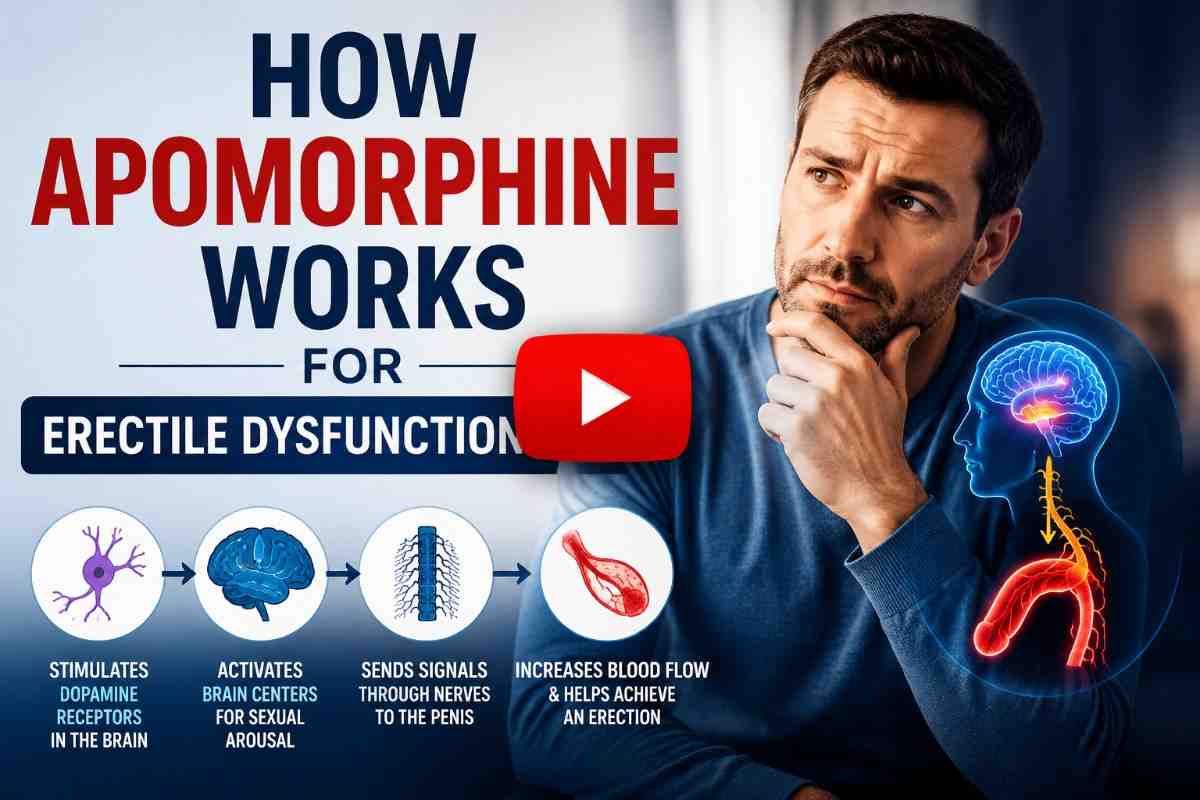
Apomorphine works by stimulating dopamine D1 and D2 receptors in the hypothalamus and other brain regions involved in sexual function.
Here is the step-by-step mechanism:
1. Brain activation
Apomorphine binds to dopamine receptors in the central nervous system.
2. Sexual arousal signaling
This activation enhances neural activity in the medial preoptic area of the hypothalamus, a key sexual control center.
3. Spinal cord transmission
Signals travel from the brain to the spinal erection centers located in the sacral region.
4. Parasympathetic activation
The parasympathetic nervous system is stimulated, promoting relaxation of smooth muscle tissue.
5. Nitric oxide release
Nitric oxide (NO) is released in penile tissue, triggering vasodilation.
6. Blood flow increase
Blood fills erectile tissue, leading to erection formation.
Importantly, apomorphine does not directly increase blood flow like PDE5 inhibitors. Instead, it enhances the brain’s ability to initiate the sexual response.
Onset of Action and Administration
Apomorphine was typically formulated as a sublingual tablet, allowing rapid absorption through oral mucosa.
Clinical characteristics:
- Onset: ~15–20 minutes
- Peak effect: ~30–40 minutes
- Duration: relatively short compared to PDE5 inhibitors
- Must be taken before sexual activity
However, it is important to note:
👉 Sexual stimulation is still required for effectiveness
👉 It does not create spontaneous erections
Clinical Effectiveness in Research Trials
Multiple randomized controlled trials evaluated apomorphine for ED.
Key clinical findings:
- Around 40%–55% of men reported improved erections in clinical studies
- Better results in mild to moderate ED cases
- Lower effectiveness in severe organic ED (diabetes, vascular disease)
- Placebo response rates were also significant in some studies
One large review published in urology literature found that apomorphine improved erection quality compared to placebo but did not consistently match the effectiveness of PDE5 inhibitors.
Key conclusion from research:
Apomorphine is moderately effective but not superior to modern first-line therapies.
Comparison With PDE5 Inhibitors
Today, ED treatment is dominated by drugs like sildenafil (Viagra) and tadalafil (Cialis). Comparing them highlights why apomorphine declined in use.
PDE5 inhibitors:
- Directly improve penile blood flow
- High success rates (70%–85% in many studies)
- Predictable and strong erections
- Longer duration options available
Apomorphine:
- Works via brain dopamine pathways
- Lower success rates (~40%–55%)
- Requires intact sexual arousal system
- Short duration of action
- Less predictable results
Because PDE5 inhibitors act more directly on the physiological mechanism of erection, they became the global standard.
Why Apomorphine Was Discontinued for ED Use
Despite early excitement, apomorphine did not remain a mainstream ED treatment.
1. Lower efficacy
Compared to PDE5 inhibitors, apomorphine was less reliable.
2. Side effects
The most common adverse effect was nausea, due to dopamine stimulation in the brain’s vomiting center.
Other side effects included:
- Dizziness
- Headache
- Fatigue
- Hypotension (low blood pressure)
3. Patient tolerance issues
Even mild nausea significantly reduced patient satisfaction and adherence.
4. Market withdrawal
In many regions, pharmaceutical companies discontinued ED formulations due to poor commercial performance and regulatory reassessment.
Side Effects and Safety Profile
Apomorphine’s side effects are primarily neurological due to its dopamine activity.
Common side effects:
- Nausea (most frequent)
- Lightheadedness
- Headache
- Sleepiness
Less common effects:
- Orthostatic hypotension (drop in blood pressure when standing)
- Fainting episodes
- Anxiety or agitation in sensitive individuals
Rare risks:
- Priapism (prolonged erection, very rare)
- Severe hypotensive reactions in vulnerable patients
Safety note:
Patients with cardiovascular disease or those taking antihypertensive medications require caution.
Who Responded Best to Apomorphine?
Clinical evidence suggests better outcomes in:
More responsive groups:
- Men with psychogenic ED (stress or anxiety-related)
- Mild to moderate erectile dysfunction
- Individuals with intact dopamine pathways
Poor responders:
- Severe vascular ED
- Advanced diabetes-related ED
- Post-surgical or nerve-damaged ED
This difference is important because apomorphine relies heavily on brain-driven sexual response, not structural vascular improvement.
Psychological Component of Apomorphine Action
One interesting aspect of apomorphine is its strong link to psychological arousal.
Because it activates dopamine pathways:
- It enhances sexual motivation
- It may increase libido perception
- It supports arousal initiation rather than mechanical erection strength
This makes it fundamentally different from physical blood-flow medications.
However, this also limits its effectiveness in cases where physical impairment is the primary cause of ED.
Why Apomorphine Still Matters in Medical Research
Even though it is not widely used today, apomorphine is still important for several reasons:
1. Understanding brain sexual pathways
It helped researchers map dopamine’s role in sexual function.
2. Central nervous system ED research
It opened pathways for studying brain-targeted sexual dysfunction treatments.
3. Psychogenic ED insights
It demonstrated how mental and emotional states strongly influence erections.
4. Drug development foundation
Modern research continues to explore central nervous system modulators for sexual health.
Current Medical Position of Apomorphine
Today:
- Not a standard ED treatment
- Not recommended in major urology guidelines
- Rarely prescribed in clinical practice for sexual dysfunction
- Still used in Parkinson’s disease (injectable form)
Modern ED treatment focuses on:
- PDE5 inhibitors
- Lifestyle modification
- Hormonal evaluation
- Vacuum devices or advanced therapies if needed
Advantages and Limitations Summary
Advantages:
- Works via brain dopamine pathways
- Rapid onset (15–20 minutes)
- Useful in mild psychogenic ED cases
- Does not directly interfere with cardiovascular PDE pathways
Limitations:
- Lower effectiveness than modern drugs
- Frequent nausea and dizziness
- No longer widely available
- Requires sexual stimulation
- Poor performance in severe organic ED
The Future of ED Treatments Inspired by Apomorphine
Although apomorphine itself is outdated for ED treatment, it influenced future research directions.
Scientists are now exploring:
- Dopamine-based sexual enhancers with fewer side effects
- Brain-targeted arousal therapies
- Personalized ED treatment based on neurological vs vascular cause
- Combination therapies targeting both brain and blood flow
The future of ED treatment may eventually combine central nervous system activation + vascular enhancement for better outcomes.
Conclusion
Apomorphine for erectile dysfunction represents a significant milestone in the evolution of sexual medicine. It was one of the first treatments to demonstrate that erectile function is not only a vascular process but also deeply controlled by brain chemistry and dopamine pathways.
Although clinical studies showed moderate effectiveness, especially in mild to moderate cases, its limitations, particularly nausea and lower efficacy compared to PDE5 inhibitors, prevented it from becoming a long-term standard therapy.
Today, apomorphine is no longer used as a mainstream ED treatment, but its scientific contribution remains valuable. It helped establish the importance of the brain in sexual function and paved the way for more effective, targeted therapies.
For modern patients, evidence-based treatments such as PDE5 inhibitors remain the safest and most effective first-line option under medical supervision.
References
- https://www.healthline.com/health/erectile-dysfunction
- https://www.webmd.com/erectile-dysfunction
- https://en.wikipedia.org/wiki/Apomorphine
.
About Us